A few days ago, I wrote about the overuse of the -punk additive in the world of publishing. The cyberpunk label lead (tongue in cheek, initially) to steam-punks/steampunk, which started some kind of not-so-tongue-in-cheek avalanche of “Punk means cool! If our thing is cool, we should add -punk to it to denote our coolness!”
It was (and still is) my opinion that that overuse “dilutes the brand“, which is a shame.
Unexpectedly, the post hit some kind of vein or nerve or alarm gong for people. Some responded with “Yes! THIS!” Some rolled their eyes and muttered “Overthinking it, dude.” Fair enough; that happens.
But the most interesting response was related specifically to steampunk, where several readers and writers of same stepped up and said “Hey! You don’t think there’s rebellion against the status-quo in Steampunk? You’re ignoring all the awesome stories about women rising up out of dismissed second-class status and making a name for themselves.”
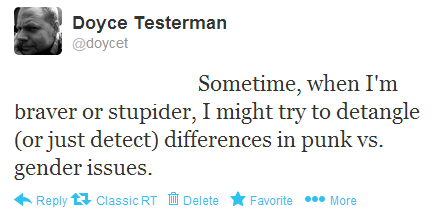
And, again, that’s fair; I didn’t ignore those stories, exactly, but they didn’t ping my radar when I wrote my little screed, because I don’t see them as the same thing as “punk rebellion”. I twooted:
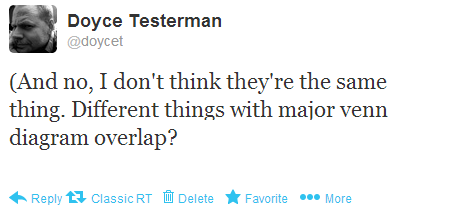
Then:
Why would I have to be stupid to try such a detangling? Frankly, because I know next to nothing about gender issues in any kind of lit. I’m not really qualified.
But that’s never stopped me before! All I need is a little encouragement.
Done!
So, stepping very carefully, I started noodling this over. I felt, and still feel, that punk-the-way-I-defined-it isn’t a very strong presence in steampunk novels. That said, I could see people’s point that there were many, as one reader put it “uppity wummanz unite!” stories in there. Not always: it’s obviously not enough to just have a female protagonist — Boneshaker isn’t about “little person against the Institution”; it’s a classic “hero journeys into Hades to retrieve a loved one” — but it shows up fairly often.
So that’s a curious thing. “Punk nobody against the Establishment” is a big part of cyberpunk, but not-so-much in steampunk, where “Smart Woman rises out of Gender Oppression” is common, instead.
And really, that’s obvious: both are frontloaded into their respective settings. Cyberpunk is a subset of science fiction for a reason: it’s usually near-future — a predictable near-future — in which corporations have become even more monolithic untouchable things than they already are. “Little guy uses tech to rise up” is obvious: tech is one of the arenas in which envision some level of equality, thanks to the early hackers that writers like Gibson heard and read about. Gender issues in a future-us setting aren’t nearly as easy to find, and in my experience they don’t find as much traction with readers (in that kind of story) — we’d like to imagine ourselves having evolved past that, at least, even if we’re stuck in some dystopian future, ground down under a corpocracy.
Which isn’t to say gender inequality issues aren’t relevant and important and a thing worth thinking and talking about: they are. Enter steampunk which, due to its sort of hazy, hand-wavey “era”, pretty much gives us gender bias as an issue by default. It’s a good match.
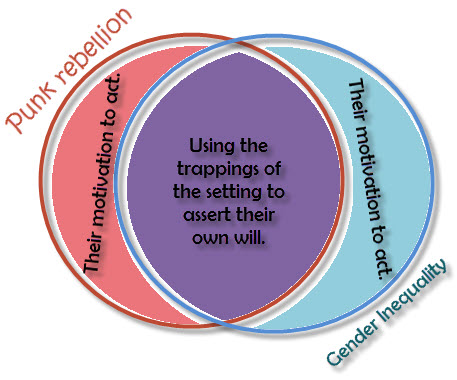
So, finally, that Venn diagram, rendered with my undeniable Paint skills:
So, in this somewhat obvious breakdown, the difference between the two kinds of stories lie in the character’s motivation, and the big overlap is in the resulting action: rebellion. Simplistic? Sure. Maybe even way off base, but that’s the spot I got to in my couple-three days of thinking about it.
And maybe that opens up the discussion of all ‘-punk’ stories, a little bit. If you solve for the common denominator in all this, you get “Someone representing a significant portion of the population (and someone we can identify with) uses the [tech] of the setting to upset the apple cart in some way. Flavor as appropriate to sub-genre, bake, and serve.”
I can accept that. That’s a reasonable way to (re)define the “-punk” umbrella.
That still doesn’t mean the term isn’t wildly overused, and often laughably inaccurate (see my The City & The City example from the last post). That is still a problem, and it’s really what I was ranting about in the first place.
But if you hand me a book and say “this is steampunk” or “this is dieselpunk”, I’m not going to dismiss it out of hand; I’m going to look (full of hope) for a certain kind of story.
I’ve known about this for a long time, thanks to buying tabletop gaming materials in PDF form, but I was reminded of it again at the MFA residency.
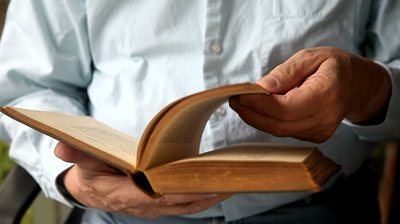
Basically, e-readers are great for reading books from Point A to Point Z, but as soon as you try to use the text in question as a reference document in any way, the whole experience falls apart, because regardless of platform,* they can’t do this:
See what’s happening there? The reader is holding their place in one part of the book, and flipping to some OTHER part of the book to check something, at which point he can flip right back to where he was, because he kept his finger tucked in at that original spot.
You can’t do that on an e-reader, be it your phone, PC, iPad, Kindle, or whatever.* Yes, you can set bookmarks (slow and annoying process on most platforms) and jump to bookmarks (equally slow and annoying process on most platforms), but (a) you’ve cluttered your document up with a bunch of cruft bookmarks you probably don’t need in the long term and (b) making and using bookmarks is pain in the ass on most platforms (I’m especially glaring at you, Kindle).
As I said, I’ve dealt with this for years with gaming PDFs and I just kind of swallowed it, because it was bearable.
I was the only person looking up whatever it is I wanted — I wasn’t trying to keep up with everyone at the table.
I could word-search for my goal, as I was usually on a PC, then word-search back. (Clumsy, but faster than bookmarks I’d never use again.)
At the time (a couple years ago) the tech related to handheld devices really hadn’t gotten to the point where I could see any other options.
But last week I had the problem presented to me in a new situation: I’d picked up the short story collection we were discussing for one of our classes, but in Kindle format rather than yet another book I’d have to lug around. Smart? Not so much: everyone else had hard copies of the text, and as we were usually discussing and comparing two if not three stories simultaneously, it became a huge pain in the ass trying to keep up with the rest of the class in terms of reading specific sections.
In short, I couldn’t mark spots with my finger and flip around.
But really, I should be able to by now. The tech has (in my limited understanding) caught up to the point where solutions to this problem can (and really should) be prototyped, as it’s the primary roadblock to heavy adoption of e-readers in academic settings.
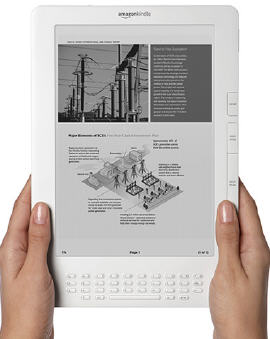
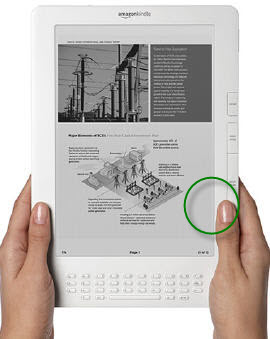
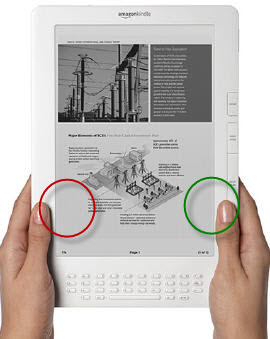
Let’s look at how this could work. Take your basic TOUCH SCREEN ENABLED e-reader screen:
Yes, I know this e-reader isn’t touch-screen enabled, but it was the first good image I found, so PRETEND, okay?
You’re reading along, you get to a point where you need to flip back to some other area in the text, but you don’t want to lose your current place.
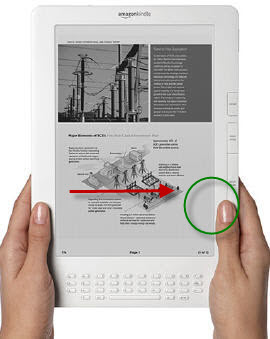
So you do this:
That’s my terrible way of indicating that that you’re pressing and holding your thumb to the edge of the screen. Got it? You’ve marked you place in the book with your finger, just like in a hardcopy of the text.
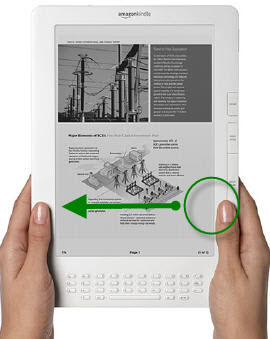
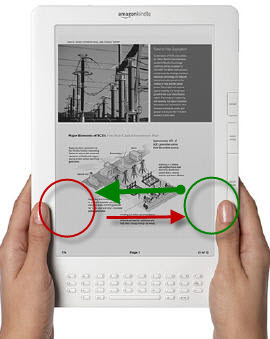
Then you flip backwards through the book by swiping the screen:
Interface designers: Bonus Points if you make more than one page flip by if you swipe harder than normal, so you can spin past a big pile of pages in a hurry. I see this kind of functionality when I’m scrolling through apps on my smartphone, so I know it’s possible.
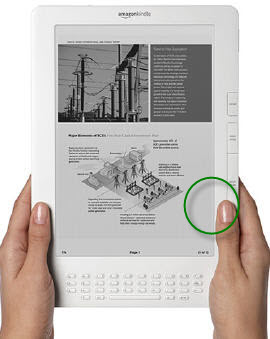
Now, you’ve flipped back to that other page you wanted. You check whatever it is you wanted to check, then you do this:
(That’s you, swiping your placeholding finger back across the screen.)
And, just like magic (or like every hard copy text in the world) you flip right back to where you started.
Would that not be kind of excellent? I think it would. As a 1.0 version of the functionality, it’s pretty swell.
Still, you could take it further.
For instance, you might need to keep flipping back and forth between two spots (during a class, for instance). Do this:
Then this:
Then THIS:
Which would let you flip back and forth between the two, like this:
Basically just holding your finger down for whichever one your flipping away from.
… or at least that should be what’s happening, because if you have to hold down your thumb on both sides, you’d need someone else to do the swiping, or you’d swipe with your tongue or… something. Best not dwell on it.
Anyway, that’s my take on the easiest way to make e-readers vastly more useful as reference tools. Thoughts?
* – If there is some e-reader or multi-touch device that does this, TELL ME.
I am constantly surprised by water as I drive north from Seattle. The mountains, while queued up in the wrong direction, are familiar enough. The evergreens are a bit shaggier than I’m used to, but I’ll cope.
Water, though: on my face, soaking into my hair, beading on my coat, streaming off the windshield, looming in the ever present clouds, weighing down the air I breathe, and even messing with my view as the miles scroll by. I live in Colorado. I like Colorado. I expect gullies. Washouts. Sere valleys. Open plains.
Instead I get water. Falls. Rivers. Bays. Oceans.
I am not where I’m meant to be. It’s a grim thought, and not the first time I’ve had it.
You might say it’s a bad way to start an MFA residency, and if you did, I’d agree with you.
A What-Now?
I’ve come to Washington for what amounts to a trial run with the students and faculty of a Masters in Fine Arts – Creative Writing program: basically an advanced degree in storytelling, if you want it simple. These sorts of things are handled many different ways, depending on the institution, but this particular program follows what’s known as a Limited Residency model, which means that most of each semester takes place online (via forums, email, and the odd Skype call) but always begins with an on-location, high-intensity, face-to-face gathering lasting roughly a week and a half. If you’re interested in the whole program but not completely sure you want to go all-in, taking part in such a residency — just the residency — is a good way to see if you like what’s being offered, and even if you don’t dig it, hopefully you’ll at least have a few sessions during that week and a half that gave you some value.
At least that’s what I’ve heard. I’m experiencing some doubts.
Preemptive buyer’s remorse, really, which tends to happen with me whenever I’ve laid down a fair amount of money for an unknown product. That’s not to say the residency fees are exorbitant — they’re quite fair, from the comparisons I’ve done — but I’m not local to the Pacific Northwest, which means I add on airline tickets, car rentals, and room and board for the lengthy stay, and it starts to seem impossible that I’ll recoup my investment in any satisfying way.
And that’s only the residency. As I drive up Interstate 5, I’m multiplying these expenses by a half dozen semesters, plus tuition for the whole program, and I start to feel kind of crazy.
Actually, crazy would be okay; I start to feel foolish.
What am I doing?
I’ve had a waxing and waning interest in doing an MFA program for quite awhile, for reasons I’ll get into, but it’s never gotten very far without hitting a roadblock in the form of other commitments, my own wariness, and most of all discontent with the programs I’ve investigated.
Yes, you are teaching an art, but whether you like it or not you’re also teaching a trade — or at the very least many of your students are coming to learn a trade, and put up with the art portion of it as part of the deal. — John Scalzi
John nails it. I’d asked around about particularly good MFA programs, got recommendations, checked them out, and saw a disappointing absence of what I chose to think of as Practical Application. Great: you’ve got the “literature” part down, but what about contracts? What about queries? What about ‘How to Act Like a Professional When Dealing With Professionals’?” What about basic self defense?
M.F.A. programs are about the creation and study of literature, and it’s worth reminding people that you don’t need any degree to be a writer. A young writer whose central goal is commercial success should skip graduate school.
That’s a quote from Elise Blackwell, director of the MFA program at the University of South Carolina. And she’s correct: you don’t need an MFA (or any education focused on creative writing) to get things done commercially. I certainly don’t have one, and there are more than a few professional authors who will advisepeopleagainst them.
After all, I can write; I believe that’s established. I’m certainly not the best anyone’s ever read (I’m not even the best I’ve read this week), but I’m nowhere near the worst, and I’d like to think I’m always getting better. I do think what a writer does is art but at the same time, like Scalzi, I believe you reliably produce that art by approaching it like a trade. Work. Work you love, but work nonetheless. (I’m not the hardest worker when it comes to writing, either, but that’s a whole different topic.)
I didn’t pursue a B.A. in Creative Writing because everyone I met in that program seemed obsessed with how to get inspired and how to act inspired (read: act especially weird and artsy), and that seemed pretty pointless. And annoying. I already didn’t having enough time to write everything I had ideas for, and I minored in Theater, so as far as artsy and weird went my ticket was thoroughly punched.
Also, I was afraid (rightly, I think) that writing classes would have the same chilling effect on my output that Lit classes had on my input. Want to know a really great way to keep me from reading a book? Tell me I have to read it; over the course of five years at college, I read exactly one of novels assigned in any of my English Lit classes — I stopped buying the textbooks altogether.
And oh yeah, there’s that: I’m a really bad student. Good teacher. Baaaaaad student.
So… Why Spend Any Thoughts on an MFA, Again?
Despite all the cons, and the fact that I appear to be doing the professional writing thing at least somewhat right, I’ve always felt that somewhere out there might be some kind of… something — a writing program, a co-op, a commune — that would present a challenge that made me push myself.
If you’re getting an MFA in writing, do it to pump the most out of the experience as you possibly can. Go to a place you feel strongly about—a place with writers in the faculty you want to know and learn from. Do it only with the expectation that you hope to get a bit better, that you’re going to focus, that you mean business. — Maureen Johnson
I was prepared to do that, but I couldn’t seem to find the right program. I’d stopped looking.
Yi Shun and her husband stopped in Denver during their cross-country move from New York to Los Angeles. We had brunch, and Kate asked how her MFA program was going. The answer was glowing and energetic (as most everything related to Yi Shun tends to be), and pulled me into the conversation, where I shared my frustration with finding a program that focused on real life more than theory.
“The program’s objective is to produce productive, publishing writers who are prepared for a life of writing.”
I got interested.
I looked at the residency schedule and saw “How to Think Like a Publisher” taught by a twenty-year veteran of a major house; “Copyright and Creative Commons in the Digital Age”; “Exploring the Excuses for Why We Aren’t Writing”; Query and Submission seminars; “Indie Publishing” and “Marketing Your Book” by a guy from Amazon.
All of which lay beside traditional courses like Craft of Fiction, Directed Reading in stuff like Mythology, and (requisite) Workshops for your own work.
I got excited. I applied and was accepted.
Then all I had to do was wait.
I hate waiting.
Waiting is where the doubts creep in. Waiting is where you start to think “It looks good on the website, but…” Waiting is where you wonder how reading ten short stories and writing five papers in eight days is going to make your next novel any better.
Waiting is where you start to do math while you drive up Interstate 5.
“Just Give It a Chance”
Day 0.
I’ve misread the schedule and arrived just in time for the faculty meeting (wasn’t invited), but two hours late for Orientation (was).
“Seems like everyone knows everyone else,” I comment to another attendee.
She looks around the room. “Pretty much.”
The drive back to my hotel is rain on the windshield and unexpectedly curving roads that hug the bay.
“What am I doing here?”
Day 1.
The morning sessions are all the traditional classes. Craft of Fiction wants a paper by tomorrow. Workshop will start with my submission, since I’m only here for the residency.
“Don’t make yourself responsible for my happiness with this thing,” I tell Yi Shun while we walk along the shore to the beach house she and a few other students have rented. “That’s not going to work out.”
“For me?” she asks.
“Also you.”
The experienced author who’s supposed to talk about commercial publishing instead details the independent co-op she founded because “there are no editors with the Big Six that actually do editing anymore.” I amazed by everything my editor has taught me (or the way the cover designer used my input to make something better than I ever imagined, or everything the publicist did for me). Silence is not my natural state. I spend the afternoon biting my tongue. Exhausting.
“You should sign up for the student reading tomorrow night,” says Yi Shun.
“From what?” I ask. And: “I’m not a student.”
“Your book. The part where she flies with the dragon.”
I sputter. Crazy idea.
Day 2.
“Did anyone have another angle on Voice for their paper?”
I look around. “I said Voice isn’t something that can be taught, only found, and doesn’t fit alongside the other stuff you cover in this class.”
The resulting discussion is energetic.
The workshop likes my piece. I take seven pages of notes before the faculty member both blows my mind and sets off several light bulbs with only a few comments.
The afternoon sessions are pretty much the same as yesterday, but I get a chance to (clumsily) tell an author how much one of their earlier books affected me as a young reader.
That night, I read the part where she flies with the dragon. It goes over pretty well.
“You’re really good,” someone tells me later. “What the hell are you doing here?”
I shrug and smile. I’m still working that out.
“I was wrong about the morning sessions being bland and the afternoon being the useful stuff,” I tell Kate on the phone that night. “It’s the other way around.”
“Which of those classes are the ones that go through the rest of the semester?” she asks.
Day 3.
I get my first shot at critiquing someone else’s work — something I’ve always been bad at and guilty about. It goes well. Maybe really well.
The first afternoon session is actual, practical information and advice. I’m almost too surprised to take notes. Almost. They fill four pages.
Day 4.
We’re discussing character development. I wrote my paper about a secondary character instead of a protagonist, because I liked him the better, and another good discussion starts up.
The workshop is a flurry of ideas and insights. I’m learning as much critiquing other people’s stuff as I did when we went over mine.
“I’m really glad you came to the residency,” one of the students tells me during the break. “Even if you’re not staying for the MFA.”
By lunchtime I’m exhausted. I’ve sold or given away all the copies of Hidden Things I’ve brought, and ask the local bookstore if they can get any more.
Day 5.
“… so what the hell are you doing here?”
It’s the fifth time I’ve been asked the question; the second time by one of the TAs for the program.
This time I have an answer, and it makes them smile.
That afternoon, I tell the director of the program I’m really enjoying the residency, but can’t commit to the MFA until I find out what’s going on with my Dad. For him and me, the best case scenario is ‘The cancer isn’t in the bones yet.’
“If the news is bad,” I explain, “my free time is spoken for.”
Day 6.
Text from Mom. Dad’s bone scan is clear. Everything’s clear.
I step outside and I call him to make sure. Neither of us quite believe it.
“I might do this program,” I tell him, walking along the shoreline.
“You should. You sound excited about it.”
I find the director just before lunch.
“Your dad,” he says before I can reach him. “How is he?”
Day 7.
In the middle of the latest workshop critique, while everyone else is talking, I figure out something about the piece we’re going over, and suggest a fix to the author just as we run out of time.
I see the light bulb go off for her, the way it did for me. Feels like giving back. Paying forward.
The guy from Amazon gives a talk that fills up five pages in my notebook.
I start filling out the paperwork with the director.
Day 8.
Outside, the sun’s shining on the bay.
“Doyce is joining the program,” our workshop faculty announces.
The owner of the bookstore brings a stack of my books over that evening, and grouses when they sell out, because there won’t be any signed copies left for the store. I tell her I’ll be back in August. She makes me promise.
Day 9.
We’re all taking notes on how the rest of the semester’s going to go. I have to leave after lunch, so I can make my flight.
I take the ferry instead of the bridge, and watch the water as we cross the bay.
What Changed?
No one inside publishing cares about an MFA. Readers don’t care. Also? They’re expensive.
All true.
They improve your skills, though.
Maybe — probably — not on first drafts, when your only job is to cut the block of stone you’ll work with later and entertain yourself. I can’t see that I’d apply most of that stuff there, or that I’d even want to.
But second drafts? Yes. Any and all editing. Yes. Explaining clearly what I mean. Understanding why something’s working, beyond simply knowing that it does. I know it helps, because I watched it happen in the space of nine days.
And, not least of all, taking this thing on scares me. I’m perverse enough to see that as a good thing.