Stories within Games

“That,” Kate said, her face lit with a kind of bemused, awestruck, lopsided grin, “was the best damn movie I’ve seen in a long time.”

The context?

This was last week. She had just finished playing Mass Effect 1.

For pretty much as long as there have been computer games, people have debated their value, or worth, or effectiveness at storytelling. Zork. Myst.

Ugh. Why make up a list? Think of pretty much every ‘big’ game in the history of at-home video games, and someone probably brought up it’s effectiveness as a story medium. Once upon a time, the line between the one and the other were stark. Limitations within the medium were evident — sometimes even celebrated — and in a lot of ways, that was seen as a good thing.

That line has gotten pretty damned thin in the last couple years, and someone drew it in charcoal. That stuff smears, man… it’s indistinct.

Me and my bias

I do a lot of gaming of all kinds, but by and large my computer-based gaming for the last four years or so has been allocated to MMOs. MMOs are fine and good things – very enjoyable, if that’s the sort of thing you enjoy – but they’re really not what I’m talking about, here. In an MMO, there may be a main but largely irrelevant-to-daily-play story line (CoH), it might be a big sandbox (Eve Online), it might be a means to play around inside an Intellectual Property you like (Star Trek), or maybe a mix.  I play a lot of LotRO, and while I love the game, I don’t really think of myself as being a star in the story — at best, I’m playing through a good stage production of Rosencrantz and Guildenstern (complete with cyclical death), knowing that almost everyone will only ever remember Hamlet, if they’re aware of the story at all.

But in the last year or so, I’ve gotten back into some ‘solo’ games. Mirror’s Edge. Portal. Left4Dead.

And of course Mass Effect and (just recently) Dragon Age: Origins. Mirror’s Edge is quite something, and a good kind of mystery/action story, but it’s really these last two games that have got my brain bubbling about successful storytelling in games.

I mean, when asked, I told someone a few weeks ago that the Mass Effect series was one of the most enjoyable books I’d read in a long time. Kate’s quote is above. Clearly, these games aren’t either movies or books, and we know that, but we say it that way because that is the best language we had to convey the experience.

Consider that for a second: it was easier and it felt more accurate for us to say “that was a great movie” or “this is a great book” than it was to say “this is a great game” or even “a great game with a good story.”

So what’s going on?

I have no idea, really. I’m still thinking on this.
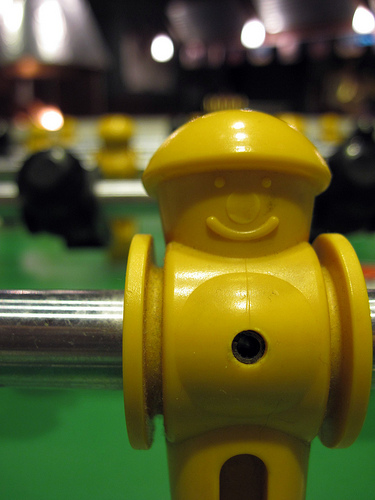
Games make Joe happy.
Games make us happy.

Chuck poked at this a couple times last week — a discussion I didn’t jump into because I was still playing through the games that I suspected might have been contributors to the brain-stew, so I’m getting to it late, but in it, he draws distinctions between books and movies as being passive entertainment, and games being more interactive and thus (I’m sort of interpreting/paraphrasing here, so apologies in advance if I misrepresent) more likely to dilute the story to the point of not being a story anymore.

In that post, regarding that passivity, Chuck said:

“Your only real options as the recipient of the [written/movie] story are: a) Keep listening (reading, watching), b) Quit, c) Change the pace of consumption.”

And my first thought was “Dude, I think I can find a post *you have written* that disagrees with that.”

I was too lazy to look for it then, but… well, I got unlazy.

A while back, I posted some thoughts about writing descriptions. Specifically, about acknowledging and utilizing the fact that the reader brings a lot of their own stuff into a story, and how to use  “less is more” with descriptions, so that the reader fills in their own stuff.

And someone commented:

My favorite thing about description is how a targeted absence of description can make something stronger. The reader will do work on behalf of the story — you never want them to do too much, but you want them to fill in enough blanks that they have ownership over it, mentally, and are as much a part of the fabric of the tale as you are.

Now, I’m not picking on Chuck — dude’s the hardest working band in rock-and-rock, as far as I’m concerned — I’m pointing out these contradictions to illustrate that even though we’ve had since Zork to puzzle this fucking question out, we still don’t have a handle on it.

All I can reliably assert it my own reaction.

“I don’t know if it’s story or not, but I don’t care too much. I’m willing to call it whatever is most useful to help get more of it.” – Rob Donoghue

Yes. A hundred times yes.

In the last… I dunno, month? I’ve played through Mass Effect 2 four times, and when the “end game” series of events starts, I never fail to find myself standing in the middle of my office, hopping up and down with excitement and cheering. It has been a long time since a movie got me feeling that good. Moreover, I have at least one other character I intend to play through the game (alongside, if not “with” Kate’s play through), and even then I know that, if I wanted, there are at MINIMUM five additional play-throughs I could do to get different end results (at least insofar as concern the characters in the story and how they “end up” at the end of the game.)

You get that last bit, though? It’s not so much the different ways the story could end — I’m a bit too much of a perfectionist to invest too heavily in one of the story outcomes where I completely fail, but I enjoy watching that conclusion on YouTube — but about what happens to the characters.

Last night I finished up my first play of Dragon Age. It’s a different kind of story — one that doesn’t leave my jumping up and down and cheering at the end, but still impacts me profoundly. In fact, I have no doubt it affected my mood for several days this week, leading up to the end, as I started to see and suspect where things were going; there are endings which are ‘better’ or ‘worse’, but none I’d wholeheartedly embrace as “flawless victory” — no matter what, best case scenario, you’re going to lose friends in the worst possible way: by driving them away from you.

I don’t think of myself as a particularly mercurial or unstable person, but I like my media experiences to engender some kind of emotional response, so while the decisions I have to make therein make me pull at my hair, I still kinda love it.

And, of course, as soon as I was done, I flipped open a new character and got the ball rolling to play it all again, but this time different.

Maybe that’s it.

When I was a kid, I remember reading Tolkien for the first time. I plowed through that epic fucking landmass of a story and, when I was done, slumped about for days because… well… the story was over, and I didn’t want it to be.

So I went back and read the books again. (And again, and again, and again. Fifteen times, before I was 20, I think. I believe it’s the desire for ‘more of that’ that led to so many very successful (if not actually, you know, good) Tolkien-esque fantasy series over the years.)

I haven’t done that with a book in a long time. I have done that somewhat more recently with movies, but it’s still not frequent.

But… man. ME2? Yeah. Dragon Age? Yep.

I mean…

What if you could read Tolkien again and have it be a little different every time?

  • … this read through, Boromir and Gimli both died, and Legolas talked Aragorn into leading Lothlorien troops against Dol Guldor, then taking the whole army down to Gondor? Rohan never even comes up.
  • … the next time, Aragorn picks the reality of Eowyn over the dream of Arwen. Legolas dies at Helm’s Deep.
  • … the next time, Aragorn picks Legolas, and Sam finally gets Mr. Frodo to see what all the hand kissing was about.
  • … Frodo dies on the way. Sam carries on, fights with Gollum and they both fall into the lava.
  • Sauron wins.

I think about what someone writing that kind of story has to be prepared to write — not just a story, but (in a way) ‘every’ story, and I’m impressed as hell.

So, if I judge a game strictly by my own personal emotional response — whether or not I have been given a story in my head to mull over and think about and ponder — then I thing yeah, the games these days are stories. Sooth. We have a whole new medium in which to enjoy a good yarn.

If I judge it by whether or not there is real story-creation going on on the part of the person/people creating the thing, then yes. Many times, yes. There’s something new going on here. Something different.

As a writer, that’s pretty damned exciting.
Keep track of yourself

Okay. This one’s been waiting awhile. Consider it a ponder-gift for the weekend.

Storytime

It’s August. It’s South Dakota. It’s hot. I’m headed back to college, driving the Brown Beater. The Brown Beater is a real piece of crap; it overheats if you idle in one place for too long, it overheats if you drive it too slow (not that that ever comes up for me), it overheats if drive it too fast, it’s ugly as hell, it’s missing the front grill (my fault), and it has no air conditioning.

So this is me: driving down the interstate on the way back to school, maintaining my speed somewhere in the high 70s, both windows rolled down, trying to figure out how and where I’m going get gas (because there’s no way the Beater is going to get me 210 miles on a single tank, but if I stop, I’ll overheat and need a half hour before I can open the radiator cap).

And the highway patrol pulls me over.

Now, let me put this in perspective: we are not talking about the enlightened interstates of the twenty-first century. Yes, even today 78 would be speeding in most states, but it’s not as much speeding as it was at that time, because back then the speed limit on the interstate was 55.

55.

78.

Pretty big ticket.

So the guy pulls me over. He’s probably having a pretty good weekend, because I am in no way the only guy driving back to school.  This is all pretty routine for him:

“Do you know how faster you were going? No, more than that. No, higher. No… come on, you’re not even trying.”

He gets my registration (which has my sister’s and dad’s name on it; short-but-uninteresting story) and driver’s license, writes down the plate number, and moseys back to his car.

I don’t know what was said on the radio when he called it back in, but I assume it was pretty routine. In any case, he came back up to the Beater with the ticket half-written, and hands me my DL and registration.

“I need to verify the VIN for the ticket,” he says.

“Whats a VIN?” I reply, sincerely, because at that time in my life, I’m totally that guy.

“It’s a…” he shakes his head. “It’s a number on a plate that identifies your car.”

I don’t point out that that also describes the licence plate, because I can demonstrate learning behavior.

Most of you probably know this, but the VIN number for most cars is located in a spot that’s pretty easy to see (by design) but pretty hard to get to (also by design) — usually under your windshield, way down in the bottom corner on the driver’s side, on a small plate that’s kind of bolted to the dashboard … really, to the part of the car that your dashboard is affixed to.

The guy steps around to look at the VIN.

He can’t see it.

Now, the Brown Beater was so-called because it was brown, not because it was dirty; the reason he couldn’t see the number wasn’t a filthy windshield, it was because something was in the way.

Or, as he put it, “there is a piece of paper obscuring the VIN.”  I thought it sounded a lot more ominous when he said it that way.

What had happened was that I’d put something up on the dash — probably months before — and it had slid down into that tiny little slot of space between the windshield and the dash, right over top of the VIN plate. This wouldn’t normally be a problem, except it was something like a business card. It was small.

It was im-fucking-possible to remove.

You’d have thought the guy had found Jimmy Hoffa in my trunk. Calls to dispatch were made to request advice. He inquired as to the availability of backup. He came back and tried to get that damned piece of paper out no less than three times, between these calls.

In his mind, that piece of paper was Hiding Something. See, the VIN was written down already. It was on the vehicle registration — he didn’t need to record it; he just wanted to make sure the two numbers matched.

But a VIN he couldn’t see? An obscured VIN? Suddenly all kinds of scenarios presented themselves. He reconsidered the condition of the vehicle. The fact that my name wasn’t on the registration. He even came back and asked me where my first name was “from” at one point. I heard him ask a couple times to verify that the car matched no stolen vehicle reports from ANY state, and “are you sure?”

I just kind of sat there, being bemused. I didn’t really see what the bid deal was; since I knew I hadn’t stolen the car, it never occured to me that he might think I had — I mean, who the fuck would steal this car, willingly? (Also, I knew I had another couple minutes of sitting by the side of the road before the Beater would cool down enough to start anyway. No rush, dude… no rush.)

But the fourth time he came back to the car, I got interested, because he told me that he’d “give it one more try” and, if he couldn’t get the “obscuring item” (dude, it’s paper) out of the way, he was going to call in and have the car towed.

Yes, seriously.

I had to act.

By which I mean I reached into the back seat, grabbed a piece of notebook paper, folded it in half lengthwise, and scooped the card out of the way. Took about a minute.

He just kind of stared. I handed him the registration again, and he stared at that too. Then he compared the two, saw that they matched, checked again, and handed the registration back.

He mustered what remaining authority hadn’t been bled away in the heat and interstate noise, admonished me against allowing “foreign objects” to slide where they shouldn’t (only moderately useful advice, that), told me to drive safe, and went back to his vehicle.

I waited.

He started his cruiser up and took off.

I… still… waited.

Then I started the Beater up and got moving again, with a pretty goofy grin on my face.

Because he’d forgotten to finish writing the speeding ticket.

Which had been the whole point in the first place.


Stay on target...
Stay on target...

It’s kind of easy to get distracted, sometimes; to lose track of The Thing This Is About because of the flashing, noisy Thing This Is Not About.

Let’s say you’re working on a story, and it’s at that point where you’re sending it out to people and getting feedback and (maybe) making appropriate changes based on that feedback. Maybe it’s your agent. Maybe it’s your publisher. Maybe it’s your reading group. Maybe it’s your mom. Doesn’t matter.

And that first round of feedback comes back and someone says:

“You know, I like it, but what I’d love to see fleshed out a little more is the relationship between the main character and the dog. The dog isn’t a big part of the story right now, but it used to be really important to her, so… I dunno, it just seems like adding some more stuff with them would add some nice depth to the MC, you know?”

And all that? That’s a good idea — one of those headslappingly good ideas that immediately presents you with about five ideas for what to write. Good stuff.

Then the second round of revisions happens, and you send it out again, and the feedback this time is something like:

“Loved it. I can really see the main character better. I saw you did some more stuff with the dog, and I liked it, but it seems like it isn’t quite clicking, you know? Maybe just a little more, to really get make that relationship crystal clear.”

And… okay, yeah, you can see where they’re coming from… and you can probably figure out a way to punch that up some. Okay…

Another round of revisions.

“Man, you are so close with that dog relationship, man. SO close. Two or three more scenes, and I think you’ve got it. Maybe something at the lake, in the summer…”

There are two things you can do at this point.

  1. Write a scene with the dog at the lake.
  2. Remember that the story isn’t about the fucking dog. Or even about the MC and the dog. The dog isn’t even a Character as much as Color.

If you chose option 1, you have lost track of what you were originally there to do.

Stay on target.
Stay on target!

We all see this. We all do this. We get hung up on one little stick-up nail, spending so much time time trying to bang that sucker down that the end of the day comes and we realize “shit, I never finished building the house.”

Arguments about whose turn it is to take the dogs for a walk, when the whole point of the day was to spend some time together, outside.

Long debates about the best way to administer a meeting instead of solving the problem that you called the meeting about.

Worrying more about whether The Thing You’re Writing is going to be Marketable, instead of whether or not it’s True.

Badgering your agent about which publishers they should submit your next project to, instead of FINISHING it.

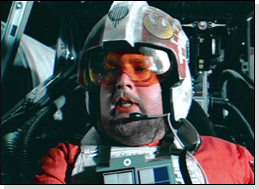
Say on... DAMMIT, Porkins!
Stay on... DAMMIT, Porkins!

This weekend, take a step back and look at what you’re doing. Think about where your head needs to be, and put it there.

Be wholly within the space you need to occupy.

It’ll feel pretty great.

The story behind Vayland Rd.

As always, Vayland Rd. is for my Dad. It’s not a subtle story, or graceful, or maybe even good — but I like it.

I originally wrote it as part of a fundraiser for prostate cancer research, which was the goblin Dad was fighting at the time. The prognosis was bad, but the end result was a full remission.

Since then, he’s fought another tribe of the little bastards, this time involving surgery around his mouth. He won that one, too.

He turns 60 today. We have the same birthday, actually.

Strong connections. Better than a silver needle in the collarbone any day.

So, on his birthday, I’ll say the same thing I said to him when I wrote the first draft of this silly, simple little story:

“You keep swinging, old man, and I’ll keep handing you the big sticks.”


Kate’s wanted to see this story for awhile, and kept asking about it, so in a way this revision is for her.

It’s also for Chuck, who reminded me of the goblin/cancer connection a few months ago.

Here’s a list of links to each part of the story, in order.

… and with that, I’m taking the day off.

Happy Birthday, Dad.

Vayland Rd. [9] — The End

~ The End ~

How do I end a story like this?

We got home with the sun coming up.  By the clock in the kitchen, my part in the whole thing had been only about twenty-four hours.

It seemed longer.

Dad was, if not ‘all right’, at least ‘alright’ in the stoic, bull-headed parlance of the Midwest. He’d survived, he wasn’t talking about it much, and I suppose I understood why as well as anyone – maybe a little bit better.

We’d made it through, and that was it. Tomorrow might be better.

Might be worse, too. Life rarely works out the way a story would, and almost never like a fairy tale.

We don’t usually get a Happily Ever After.

But we don’t have to settle for The End, either.

Vayland Rd. [8] — The Fall

~ The Fall ~

One of the real people walked up to him. He was limping, and had a

my

gun in his off-hand.  There was a big stick in the other.

”It’s time to go home, Dad,” the young man said.

Steven looked up at his face, with its hurt eyes, and frowned.

”I think that he will stay here.” Churkk’s voice was the same as always.

The real person glared. “His choice, not yours.”

Churrk grinned. “Or yours.”

The man scowled at this, but nodded. Steven could feel Churkk’s surprise that he

Sean?

understood that much; that he –

”Dad?”

Steven looked up.

”I’m here.”

is he?

”Can we go?”

Do you dare?

Steven shook his head; a tiny movement that seemed to pull the strength out of the younger man.

Churkk chuckled into the silence. It sounded like someone with a collapsed lung. “Seems ‘e might stay with me.”

The man glared again, his hand squeezing knuckle-white on the club. “He can do what he likes, but I’ll still cave your fucking head in.”

“The end result‘s the same,” Churkk wheezed. “What d’you think, Stevn?”

Churkk was doing more than asking. Steven could feel the needles pulling.

But the man, the real person, reacted to it too, stepping forward and starting to lift the club. ”You let him –”

“Sean.” His voice sounded

like Churrk

tired. Unused.

The man jumped. “Dad?  Are you–”

”Give me that stick.” Steven’s head was very heavy. The weight of the needles pulled at him.

Silence.

“Give it to me.”

Sean did. Steven accepted it, and let it hang at his side, dragging in the dirt. One of the other people behind Sean make a noise… not even a word.

It was Churkk that finally spoke. “He understands, Sean.” There was a dry rasping sound as it licked its lips. “You’ll understand too, someday, I think. Heh.”

”Damned if I will.” Sean said flatly.

Steven’s head came up.

Damned if I will.

Steven swung as he turned, hard as he could.

Sean almost killed a cow with this goddamned stick one time, when he was fifteen; s’why he only got to use it around the bulls after that.

He only swung once.

After that, everything was quiet.

Vayland Rd. [7] — The Fight

~ The Fight ~

Most people, sitting back on their couches and watching this play out on television, might have wondered why I believed all this from the start.  It was a good question; if I’d wrtten it out as a story, my main character would have yelled bullshit as soon as Brock and Bhuto showed up and then spent most of the rest of the story being convinced it wasn’t all some kind of dream.

I saw a goblin shambling along the bottom of a ravine with an old, rusted sword balanced across his shoulders like the yoke of a wagon. Even at that age, I assumed I’d imagined it.

Except I hadn’t; not really. My life had gone on — I wrote little stories that I pretended were just stories until even I gave them — but there was always a shadow in the back of my mind that watched the ravines and kept an eye on the alleys that led around to the back of old houses — a part of me that never really believed I’d made it up.

When the goblins boiled out of the thickets around us, waving swords and screaming for blood, that small dark shadow stood up and shouted ‘I fucking KNEW it!’

And it turned out Brock was wrong.

The gun worked just fine.

On the other hand, I didn’t work all that well a first.  There’s a hell of a long distance between target practice, hunting for food, hunting for sport, and finally shooting at something that could talk back to you, even if it was running straight at you and swinging hunk of metal at your head.

The first one would have killed me, I think, except that Brock was there. He had his axe out (‘of course he has an axe; every dwarf would have an axe if they could, I guess’ came the errant thought) — a great, beautiful thing of which I’d only previously seen the polished grip — there was a crescent flash, and the goblin-thing was dead on the ground.  Brock clapped me on the shoulder and grinned.

”Dirt-eaters,” he drawled, and I noticed for the first time that his eyes were a bright, clear blue.

I shot the next one before I had a chance to answer him, and after that there wasn’t much time to think.

—-

They’d had to tie him to the Turning Tree for the whole ritual.  The bristlerope had rubbed him to the meat everywhere it had touched him, from the struggle.  He’d done it to himself, fighting them throughout the Anointing, and he was proud of himself for that.

How do I know the names of those things?

He was back in

not mine. NOT mine.

the cage now, and he knew it was the last time he’d get out until they put him in a sack or he walked

shuffled

out on his own.

Or he could escape.  He’d done it once, and the burning on his skin wasn’t even as bad as before.

Or you’re getting used to it.

Or he was — no. It was time to go.

But where will you go?  What if –

”NO!”

No one in the camp looked at him.  He wasn’t even sure if he’d really shouted. He

Steven.  Not ‘he’. Steve. Steven.  My name is Steven.

Right.  Steven.

Steven sat in the cage that wasn’t his and watched the stars, which he still recognized, and repeated his name.

—-

I was sitting on a rock in Faerie. Faery. Fae. Fae’ree. Wa’ri. Whatever. Dirt, or spattered blood, or sweat, burned my eyes. A half-moon hung overhead, leeching the color from the scene of battle. Our battle.

I think I was smiling.  Bhuto and Brock were not.

”The hell’s the matter with you two? We won.”  I scrubbed an itch on the side of my face.

“How’s the pain?” Brock asked.

I frowned and looked down at my shirt. “What pain? I didn’t get hit. None of us got hit. They all got hit,” I pointed at the sprawled bodies around us, “but not us. We won. That’s what that means, right?”

Bhuto’s face didn’t change.  “He means the needle, Sean.”

I stared at him blankly for a few moments before I understood his meaning. “Oh. Ah. Fine. No pain at all.” I patted my collarbone lightly to prove my point, and it wasn’t a bluff — I didn’t feel a thing there except the direction we needed to go.

Bhuto frowned and looked at the dwarf, then back to me.  “How close are you and your father?”

My turn to frown. “I don’t know. He’s my dad. Close enough.”

He’d understood me; that much was clear.

I watched the two of them exchange looks. “What’s the problem? You two look like your dog died and I finally feel like I know what’s going on.”

Bhuto nodded. “You certainly seem comfortable here.” His lips worked, as though he were selecting his next words by taste. “Usually there is more… discomfort.” He shook his head. “I think there’s been a mistake made, Sean.”

I waited.

”You are very comfortable here; you are compatible. You are also strong.” He indicated the corpses. “You remember what we told you of what the… goblins?” He looked at me for confirmation of the word.

I nodded.

”What the goblins planned for your father?”

I nodded again, not liking the turn in conversation. Nothing they’d told me about that had been good.

“You’re a good match to your father; a strong match. It’s possible that what happens to him will carry over to you through the link we created, which is so strong it does not even pain you.” He gestured at my chest. “It even more possible that by bringing you here, we’ll bring you to the attention of those you’d do best to avoid.” He looked at Brock, then back at me. “You might recover your father and find yourself in the same danger, or worse.”

I stared at him.

Then I chuckled. I couldn’t help it. By the look on his face he thought I’d cracked.

”This,” I said, waving my arms all around me, “is about my dad. Not me. Him. His fight. I’m just here to help.”

”But–”

“Shut up.” I said, and glared. “Thank you for the warning, you are a good friend.” I looked at both of them. “Now,” I pointed. “He’s that way.”

—-

Finding the camp didn’t turn out to be that difficult. We watched the place through the tail end of the night, waiting for the thing that passed for dawn. Waiting to see my dad.

Light came back slowly; we made plans and talked of small things.

Just before we moved, I said, “how many have you gotten home?”

They looked at each other. “Many.” Bhuto said.

”Not all?”

”Not all.”

I nodded.

—-

The morning didn’t come the way Steven thought it would. It was much noisier. There were screams and people hollering

dirt-eaterrrrrs!

and an echoing crack.

I know that sound.

Then his cage shook and one of the members of the camp was leaning against his cage. Its beady eyes looked straight in at him, but they were cloudy. Blank.

Dead.

Its knife had fallen just outside the

not my

cage. Much easier than working the ties with his fingers.

Moving very slowly, so that he wouldn’t have to argue with the other voice, he reached out for the tool and started to cut. The camp got quieter around him. The little explosions stopped

ran out of shells

somewhere in the middle. He got the gate open and pushed. Easy. He dropped the knife on the floor of the cage and crawled out.

A few feet away, three real people stood.

And Churkk was right behind him.

Vayland Rd. [6] — The Needles

~ The Needles ~

I stood on the edge of Vayland, looking down into a ravine. Silver pain pulled at a single point in my body, dredging up memories.

When I was a kid in the first house my family ever lived in, my room was next to the living room and, thus, the television.  After bedtime, whenever I heard the television and no conversation, I would slowly open my door, crouch down next to the floor, and slide into the room on my stomach. My door was right next to the foot of the couch back then, and sat directly between the couch and the T.V., so if I was quiet, I could curl up on the floor and watch TV while my Dad lay not three feet away on the couch.

Some nights, I would fall asleep while watching. What happened next depended on who found me; regardless, I would always wake up in my bed the next morning, like magic, but if my mom had found me, I would get a lecture during breakfast about needing my sleep.

Dad never said anything. I suppose he thought that, between the floor and my bed, I’d gotten enough sleep.

He understood; that much was clear.

When I opened my eyes, we weren’t on the road anymore.

—-

The cage really wasn’t all that difficult. There were no locks, only tie-downs, which weren’t a problem if you ignored the burning of the mud. He’d driven seven loads of winter wheat to town while running a temperature of a hundred four; if he really wanted to, he could get the damned cage open.

Eventually, he proved himself right, although the sweat in his eyes burned almost as badly as his skin.

He slipped past the smallest number of huts possible to get to the edge of the camp, not knowing where he was going except away.

Just past the last hut, it got difficult to walk.

Twenty paces later, the needles started to burn like over-extended muscles. It felt as though he was trying to pull a truck with chains attached directly to his body.

”Stevn,” came the phlegm voice. He was too focused to jump.

”Where are you going, Stevn?” The voice was right in his ear, it seemed.

”The hell… away…” Steven didn’t even know if that was an answer or a command.

”What if there’s no one waiting for you?”

The thought bored right to the base of his brain and waited for him to give. He wasn’t going to. He knew if he could just get a few more steps, he’d be free.

But what then?

What if…

When blunt fingers wrapped around his arms, he was already on his knees, looking up at the sky.

—-

Brock was standing at my elbow. Somehow, the smell of him didn’t seem overpowering anymore.

It’s not. Here, it fits in. It doesn’t clash.

I shook my head, partly to clear it. “Sorry, what?”

He watched me for a few seconds. “How’s the pain?”

I started, suddenly sure I’d lost the needle, and felt for it just below my right collarbone. Still there. Still there? I frowned. “There isn’t any pain.” I looked at him. “Not that I mind, but you said the pain would pretty much stay constant.”

Brock looked at me, then glanced over his shoulder as Bhuto emerged from the gray-green scrub where he’d gone scouting. “I was wrong.”

I wanted to ask what else he might have be wrong about, but the look on his face made me think better of it.

We started moving. The way they’d explained it, we’d still have a long way to go even after we came through. Now that I was here I knew that was true; I knew exactly where we needed to go. I had no idea what lay between here and there, but I could point out the direction we needed to travel with my eyes closed.

I did, and we walked into the land of the fae.

Hours passed, during which the ache in my legs and feed subsided into a dull burn, giving me a chance to take in the sere landscape and starry sky. “Are there territories?” I asked of no one in particular.

Brock glanced around. “Here?”

I nodded.

“Aye,” he said, “we’re nowhere near a friendly place or one of those princess palaces they put in those ridiculous fairy books, if that’s what you’re thinking.”

“You should read one of those books.” I let my expression convey what I thought of his guess. “I have, and I wouldn’t go near one of those palaces.” I rubbed sweat out of the corner of my eye. “Why aren’t there any friendly territories around here?”

He shrugged, looking around. “Dirt-eaters lose most of the fae wars. The losers get driven to the hinterlands, and these are they, no offense.  Even on your side of border, it’s nothing but violent winters, vicious heat in the summers; it’s the worst of all the worlds in one place. The things that survive here…” he broke off a branch from a bent tree that seemed to have grown up in the middle of a high wind. “They don’t have much choice.”

I frowned, feeling like I should be on the defensive. “At least they’re strong enough to take it.”

“Oh, aye.” Brock grunted. “That’s why the dirt-eaters want ’em.”

I didn’t understand what he meant, but Bhuto hissed a warning before I could say anything.

—-

They let the thing that used to be Ted Schafer out of his cage that morning. The clouds weren’t a complete shroud over the camp, but it didn’t really improve the light; the sky was the wrong color to begin with.

There weren’t any helpers to clear away muck and detritus from Schafer’s body; it wasn’t necessary. The last batch of muck — Steven understood that that meant the third batch — was left on until it was absorbed almost completely, over the course of weeks. The camp then waited to see if the captive lived or died. In Steven’s opinion, Schafer had been unlucky.

There weren’t even any needles left to remove.

The tall creature stood before the Schafer creature in the center of the gathering and spoke in its gurgling hiss. “You have lived.”

The Schafer-thing wobbled its head.

”You are part of us now. We are part of you. I am Churkk. You are Zef.”

The thing paused, cocking its head as though listening to a distant sound, then nodded. “Zef.” It swayed slightly, and several of the creatures came forward to help it to a hut.

Churkk turned towards Steven’s cage. “It is the third day.” It gurgle-growled, and its smile returned.

This time, Steven fought.

Vayland Rd. [5] – The Quest

~ The Quest ~

Twenty minutes later, I was ready for whatever they were going to tell me.

The dwarf and the ogre were looking doubtful.

“I don’t think those work where we’re going.” Brock gestured with some distaste at the gun slung over my left shoulder.

I raised an eyebrow. “You ever shot a gun, Brock?”

The dwarf glared at me, finally shaking his head.

”Then how the hell would you know?”

He shrugged. I ignored him. The gun was an open-sight .300 Savage; a family heirloom that my great-grandfather had bought the year of its making. My grandfather had an alaskan grizzly pelt in his guest bedroom the gun had taken. The stock was solid hardwood with a stainless steel shoulder plate; the barrel was three and a half feet of blued steel. Frankly, if the thing didn’t fire ‘where we were going’, I’d could do worse than just hitting things with it.

Bhuto had a different problem. “Do you not have a more… formidable hand-weapon, Sean?”

I readjusted the grip on my old ‘herding stick’, which I’d found in a barrel of similar tools in the machine shed. I’d cut it from an ash tree when I was thirteen and had used the four-foot club whenever I had to push one of our bulls into a new pasture, on foot.

I could have explained all of that to them, but as far as explanations went, I didn’t really feel like it was my turn.

I motioned towards the trees behind the house. “Let’s just go.”

—-

When we got to the edge of the trees farthest from the farm, Bhuto extended his hand to me for the second time, doing the same for Brock. It was my turn to look doubtful.

”Explanations come shortly, Sean, but we need to move quickly now, when we are not marked by others.” Brock said. “I can assist with that.”

I almost refused, until I saw Brock’s expression. However uneasy I felt, the dwarf was far worse, and part of me wanted to see why. I took the ogre’s hand.

I’m not sure what I was expecting… a puff of smoke, a swirling of my perceptions, maybe. When we just shot off the ground and into the sky without a word or gesture, I couldn’t help but shout.

—-

The night passed and the clouds rolled back in on cue.

They came for Steven not long after and started again.

First they stripped the mud away with blunt fingers, accomplishing in less than a minute what had been denied him through the night. The mass came away in huge chunks, dry and dusty, though it had clung like putty the day before. They finished the cleaning with an orange-tinted liquid that foamed when it hit made the the needles burn all the way down to his joints. Completely clean, his skin had a greyish cast — probably the light from the clouds.

Then they tied him to the tree again and brought a new cauldron of the mud. Packing it back on took most of the day. The tall one watched the whole thing without moving or relaxing its corpse-smile.

Steven never made a sound. Damned if he would.

The worst part of it was when they put him back in the cage.

My cage.

The day ended, the clouds pulled back, the stars came out, and he wondered for the first time if anyone would come.

—-

We landed on a curving stretch of blacktop a few miles away from the farm. Ravines dove away from the road on both sides.

I shook my head. “Why are we here?”

Bhuto looked up at the sky. “This is the only place we could be, Sean. We must reach your father.”

“Oh.” I thought for a second. “You do realize that’s the most pointless, circular answer I’ve ever heard, right? And I went to a liberal arts college.”

Brock advanced toward me as Bhuto sighed. Much to my dismay, he didn’t stop until he was nearly touching me.

”What do you call this road?”

My eyes were watering. I blinked rapidly and focused on the question. “Ahh. Vayland. Vayland Road.” The problem with people telling you to breath through your mouth when around a bad smell is that instead of smelling it, you taste it.

He smiled up at me and I was glad for the darkness that largely hid his teeth. “Why is that?”

”Why is what?”

”Why do they call it that?”

”Because…” I thought about it. “I don’t know why.”

His smile broadened and I had to take a step back. “Let me tell you why.” He turned away from me and threw out his arms. “This place is a border between realms. The very first people who lived here and named things called the people on the other side wa`rii we because they didn’t understand. Others came and gave the border different names. When the people of my lands came,” he thumped his chest “they took the names it had already and translated the words and the idea. They called it a fae land.” His eyes glinted as he turned back to me. “You know what that is?”

I nodded, not bothering to explain why.

He spun on his heel, pacing toward the shoulder of the road. “The border to the fae land was marked by those who knew enough about it, and the name stuck, changing, after they’d all gone to dust.” He spat on the blacktop. “Then some dog-buggering half-wit built a road here, since the markers were already there. No one remembered that they were meant to show you where not to go.”

“Sounds like the sort of thing someone would do,” I said. “And I suppose I get why we’re here.”

“Do you.” Brock wandered in a wide circle around us.

I didn’t bother answering him. “What’s next?”

Bhuto studied me for a moment. “That is something you will tell us, Sean.”

I raised an eyebrow at him. “Really?”

”Understand, we are here to help you, but we are also here to help your father, and we could not — can not — do that without you.” The ogre pointed to me with a knobby finger that ended with an elegantly painted claw. “You are our link to him.”

I looked up at the stars, letting myself marvel for a second at how many more there were away from the city, then blew out a breath between my teeth.

“Okay,” I said, “what do I do?” I was looking at Bhuto, but he gestured to Brock.

Brock was holding a silver needle.