
Jonathan Coulton » The JoCo Primer
My name is Jonathan Coulton and I’m a musician, a singer-songwriter and an internet superstar. This site is chock full of music, news and me-related merchandise – if you’re not that familiar with who I am and what I do you can use the links above to get started.
First: Johnathan is a great musician, and his songs are fantastic. You should be listening to him.
Second: this is a really smart series of pages for introducing new fans as well as suggesting where to go next. Steal this idea, internet people.
Unexused Absence
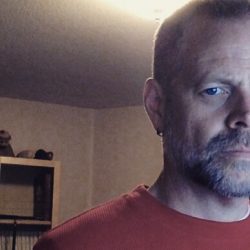
 Like the picture?
It’s like my life at the moment: cool, but complicated.
I didn’t mean to be ignoring you, internet, and as a matter of fact, I really haven’t been — there have been a number of emails to large (and not so large) groups of people going out, and lots of posts to various forums, and even a couple posts to my gaming-related blog.
I just … ahh … forgot to post anything HERE. Right, then, moving on?
Work (in which I am currently building an interactive online course for basic Outlook use… which is a lot cooler and MUCH harder than it sounds) is going swimmingly, though it is jamming up quite a lot of my FM dial, so to speak.
We, the newlyweds are good — we’ve got almost everything unpacked that needs unpacking, and next week my parents are in town and we’re going to replace almost all the carpet on the first floor with laminate flooring, because there’s nothing I like better than coyotes on iceskates excited dogs on a hardwood floor.
Kaylee begins preschool next month. She is very excited. We are very excited. I think it’s going to herald a true sea-change for her in terms of development. And diapers. Did I mention the excited?
Anything else? A lot of geeky gamer type stuff, but nothing worth noting at the moment.
Oh, just as a historical note: Obama’s going to be our Democratic nominee, and I’m voting for him. Also, someone in the House filed papers of Impeachment for George W. Bush. Now if Cheney would only resign for medical reasons, it’d be a pretty good month.
It’s going to be very interesting around here, come the election time — mine might be the only Obama sticker in the parking lot at work… perhaps in the whole neighborhood. At least they’re all relatively cordial about it.
It’s not so much a sunburn as it is a slow baking
 We got back from Cabo late last afternoon, mostly no worse for wear; Kate had a run in with a jellyfish (as did I to a much smaller degree) that left her less than a hundred percent, and I think we’re both running a little low-energy, but otherwise, everything is good. The trip was a lot of fun, though it was more of, say, a “resort vacation” than a “Mexico vacation.” In either case, it was a wonderful chunk of quality together time, interrupted at scheduled times with parasailing, snorkeling, and sunset sailing excursions.
While driving up the Pacific coastline in a rental car on Sunday, Kate and I discussed the different kinds of a vacation options a person really has. Those options we boiled down into a kind of grid on which “Things to Do” was one axis and “Things to See” was the other. Our Prague trip was very strongly on the “Things to See” end of things, which Cabo was definitely full of “Things to Do” (even when those things are “sit around the pool and read while people bring you margaritas”).
Some vacations or vacation locations are more successful at blending the two basic types. Likewise, certain people might enjoy a mix, or at least can do one and then the other and enjoy both (we are two such people).
Trouble arises, however, when you try (for instance) to fill a day with Things to See in a locale that’s entirely (and unapologetically) geared for Things to Do (or vice versa). Ironically, we were actually en route to make EXACTLY THAT MISTAKE on Sunday, while we were having this conversation. Lesson learned — something to file away for the next grand adventure.
Right. We’re home again, the little girl is wonderful, the dogs are exuberant, and Other Things are going on…
* The author of one of the games I’m editing is wilting in the face of unenthusiastic playtest reviews. I’m trying to shore up his resolve and enjoyment for the game he himself invented, but I don’t know if I had much impact. It may be as he says — that I am one of the game’s biggest fans and truest member of its target audience. We’ll see. For now, I’ll work on other things.
* The little writing project I mentioned last week is ch-ch-chugging along. One person (of course) was told what it was, and was visibly nonplussed, but I’ll keep at it at least for a little while, because I’m enjoying it, and I like it when I can entertain myself.
* Gregory Frost, best known and recognized for solid short story work, has turned that knack into a full length novel through the charming and engaging trick of making a storyteller his main character. That novel is Shadowbridge, the first in a two-part fantasy that I want to recommend. You’ll find I don’t recommend books nearly as much as I do movies or television, so take from that what you will. It’s good. It’s entertaining, and it often interrupted other good vacation activities (drinking, napping, sleeping) so that I could read a bit more. For those who don’t like starting unfinished series, rest assured that the sequel is already out.
* My sister seems to think Kate and I should run a half-marathon. In the middle of summer. In South Dakota. She’s absolutely, wall-bouncingly mad, but I love her. Family, you know…
We don’t actually like the same things.
Your friends are not playing the same game you are.
You friends are not reading the same book you are. (Hell, my friends aren’t even reading the same book that I write.)
Your Friends Are Not Watching the Same Show You Are.
It’s all about falling down, even after all this time.
Your $x (whatever your reason for it) is not some fragile vase that is going to shatter the second you $y. It is as strong as you decide it is, and the boundaries are where you set them.
I’m sure that this is obvious to other people, but it is not obvious to me: it’s okay if I’m not perfect. Really, it is. My writing is not some fragile vase that is going to shatter the second I split an infinitive.
It’s an interesting post — the way I read it, it’s about paralyzing yourself with the fear that you’re going to fail.
Here’s a post I wrote back in 2001.
Part of reason that I’m not more involved in ‘traditional’ creative writing is that I’m comfortable with what I’m doing already: I’m good at it. I’m starting to realize, though, that sometimes you need to do things you suck at.
Failing is the thing we fear, but failing the only way we change; it’s absolutely natural. School teaches us to fear failure — by extension, we learn to fear change.
I don’t know that I have a whole lot to add to those two quoted passaged, even after this much time has passed.
I’m working my way down the road one dangerously comfortable rest area at a time, trying to reach places I’ve never been before, doing things that, if you’d asked me five years ago, I would have been entirely unsure about.
Things that I will, without doubt, fail at the first time.
I hate that, but at the same time, it’s my favorite part.
The more new things we try — the more we step outside our comfort zone — the more inherently creative we become.
Why YA
John Scalzi on why many adult science-fiction and fantasy authors are missing out on the best sci-fi and fantasy being written today.
Last week, the top 50 YA SF/F bestsellers outsold the top 100 adult SF/F bestsellers (adult SF and F are separate lists) by two to one. So 50 YA titles are selling twice as much as 100 adult SF/F titles. The bestselling YA fantasy book last week (not a Harry Potter book) outsold the bestselling adult fantasy book by nearly four to one; the bestselling YA science fiction title sold three copies for every two copies of the chart-topping adult SF title. And as a final kick in the teeth, YA SF/F is amply represented at top of the general bestselling charts of YA book sales, whereas adult SF/F struggles to get onto the general bestselling adult fiction charts at all.
That serious adult science fiction/fantasy readers don’t seem to know any of this is a) a feature of the opaque nature of book sales, in which no one publicly talks about actual units sold and b) a feature of the apparent short-sightedness of adult sf/f readers, who are missing a genuine literary revolution in their genre because the YA section is a blank spot on the map to them, if not to everyone else. “Here there be dragons” has been replaced by “Here there be pre-teens” or something of the sort. This attitude is especially puzzling when you consider how many SF/F readers got their start with books like the Heinlein juvies, the fantasies of Susan Cooper and John Christopher and Madeleine L’Engle and so on.
I’ve said it before and I’m sure I’ll say it again: The most significant SF writer right now is Scott Westerfeld, whom it seems most adult science fiction fans still have not read and indeed barely know exists. In a sane world, Westerfeld would be a hero to adult science fiction readers, because he’s pretty much single-handedly flown the flag for science fiction to teenagers, thus saving the genre’s bacon for another 20 years. But: He’s YA. So he doesn’t count.
In my local group of reading-friends, one of the most voracious of readers has few if any qualms about picked up, devouring, and sharing out many YA titles. Most, however, have probably never even looked twice at (or heard of) Pretties/Uglies — I have heard of them only because Kate specializes in YA and middle-grade fiction, and adores the series… I’m ashamed to admit I haven’t read them myself.
Yet.
Pretty sad, considering the kinds of stories I write.
In which I compare my child to Shakespeare

I am a language nerd. Although I agree with Steven King’s assertion that any word you have to stop and look up in the thesaurus is the wrong word for whatever you’re writing, I really do love the way words fit together and the kind of lyrical wonder they can create when they’re strung together in pretty way (or — less pretty but more impressive — stacked up like a Jenga block).
It’s that kind of haphazard, teetering construction that I’m thinking about today.
One of the truisms of English lit that gets tossed around is that at the time that Shakespeare was writing, the English language was approximately one-fifth the size that it is today. One of the reasons that ol’ Will and his compatriots were notorious neologists (Shakespeare is credited with the invention of anywhere from 500 to 1700 new words, many still in common use today) was simply because they kept reaching for tools that not only weren’t there, but hadn’t been invented yet. The same is true of certain phrases and expressions.
What fascinates me is that I get to see a similar kind of lingual evolution on a day to day basis with my daughter. Granted, she is not (yet) Shakespeare, but she does face the same challenges faced by anyone trying to communicate in that era; a limited set of words from which to choose. In some cases, she points or otherwise indicates what she’s trying to say; in others, she uses the wrong words in hopes of (I think) being understood anyway.
But in others, she pulls a jenga block from the bottom of the stack, and moves it to the top of the tower. This leaves gaps, to be sure, but she gets to a place she might not otherwise have achieved, and in ways that expand both her understanding and mine.
Example: a few weeks month ago, she and I were lazing about the house on a Saturday. Actually, *I* was lazing, and Kaylee was restless and wanted to something — anything — more interesting. She was bored.
The problem was, she didn’t know the word ‘bored.’ For all she knew, the word for what she felt right then didn’t exist. (It didn’t exist in Shakespeare’s time either, and wouldn’t for almost 200 years.)
So, with this unnamed feeling, Kaylee came to me.
“Daddy?”
“Yes, Kaylee?”
“I’m… sad.”
“You’re sad?”
“Yes, I’m sad… and tired.”
“Ohh, that doesn’t sound good.”
“Yes. I’m sad, and I’m tired… and I want to DO something.”
Sad, and tired, and I want to do something; three linguistic jenga blocks stacked one on top of the next to reach bored. I understood her meaning perfectly, because it was a true and accurate summation of everything she was feeling right then; and far more informative than the single word.
I wonder, sometimes, if all the extra tools we have to work with in the language-as-it-exists-today make us better able to communicate, or actually prevent us from exercising some of our creative and analytic muscles.