Choose Your Doom

Bet you thought this was going to be a NaNoWriMo post.

I mean… come on: Middle of the month? Ironic yet clever title? Something about conserving ammo, checking your exits, and knowing when to double tap your closest friends to maximize your own life expectancy? Clever analogies… OR ARE THEY?

But no.

Today, I don’t want to talk about writing; I want to talk about reading.

Specifically, I want to talk about Choose Your Adventure books and the cultural wasteland of my youth.

Where the Outbreak Began

A few things that have always been true: from as early an age as possible, I’ve been storyteller, a reader, and a gamer. Also, I grew up deep, DEEP in the heart of the Great Plains about an hour from Laura Ingalls Wilder’s old place (seriously). My only playmate for five miles in any direction was my sister.

We got in a fair amount of trouble.

And by “we” I mean “I”, and by “I” I mean “I’m still really very sorry about accidentally spraying that superglue in your eyes, sis.”

My parents (and my relatives, and our neighbors) were very enthusiastic about anything that might keep me busy for a few hours that didn’t involve me trying to construct a functional airplane from a 2×8, our welcome mat, and a plugged-in battery charger I was about to clip to my belt buckle. (True story! Short, but true.)

As a result, people got me copies of every Choose Your Adventure book ever printed. In some cases, I had two. In the eyes of my gift-givers, they were the perfect combination of elements: a story! but a story he made up himself (kinda)! and you choose paths, like a game! Seems an obvious choice, really: I can see why folks picked them up for me by the five-pack. There was only one key bit of trivia they overlooked.

They were positively execrable. Holy pinball-tilting buddha, they were bad.

You know what I used to do with the CYA books? (Never did a three-letter acronym serve multiple masters so admirably.) I used to read them in page order. Not because I didn’t understand how they were meant to be consumed, but because digesting the elements of the product as a mishmash of unrelated plot points, sappy successes, predictable reveals, and weak failures was not, on the whole, any worse. Also, when I did it in that order, I could make up the interstitial stuff that lay between each page so that the whole thing still (or, finally) made some kind of sick sense.

That was my experience with Choose Your Adventure books when I was a kid. (A few years ago, someone gave Kate a copy of a CYA reprint at a book fair. It did not encourage me to revise my childhood impression.)

The Infection Spreads

You can, given this background, imagine my terrified caution when I learned of a new book coming out. It’s called Choose Your Doom: Zombie Apocalypse, and it looks like this:
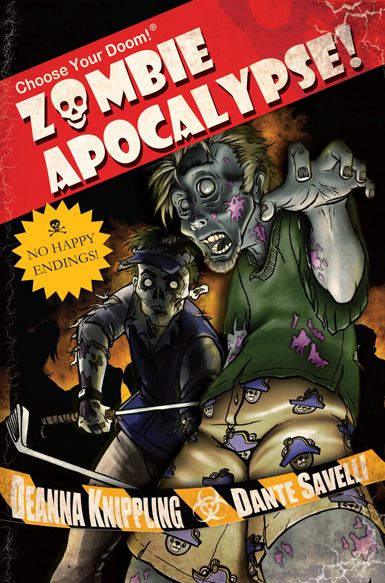
Take a look at that cover. I’m not really qualified to discuss nuances in a piece of art, but I feel compelled to point out it’s got zombies in it. I believe my love of zombies is well-documented.

But then there’s this cover copy.

You control the fate of Tobe, a teen-aged slacker living in the shadow of the Cheyenne Mountain military complex. When a secret experiment goes awry, the citizens of Colorado Springs are exposed to an alien mold that turns those infected into zombies. With your help, Tobe must battle the newly undead, wild animals and the most dangerous creature of all: Man. Will your decisions help him save the city, or lead him to certain doom?

Obviously, I was torn. On the one hand, you have this:
But on the other, this:
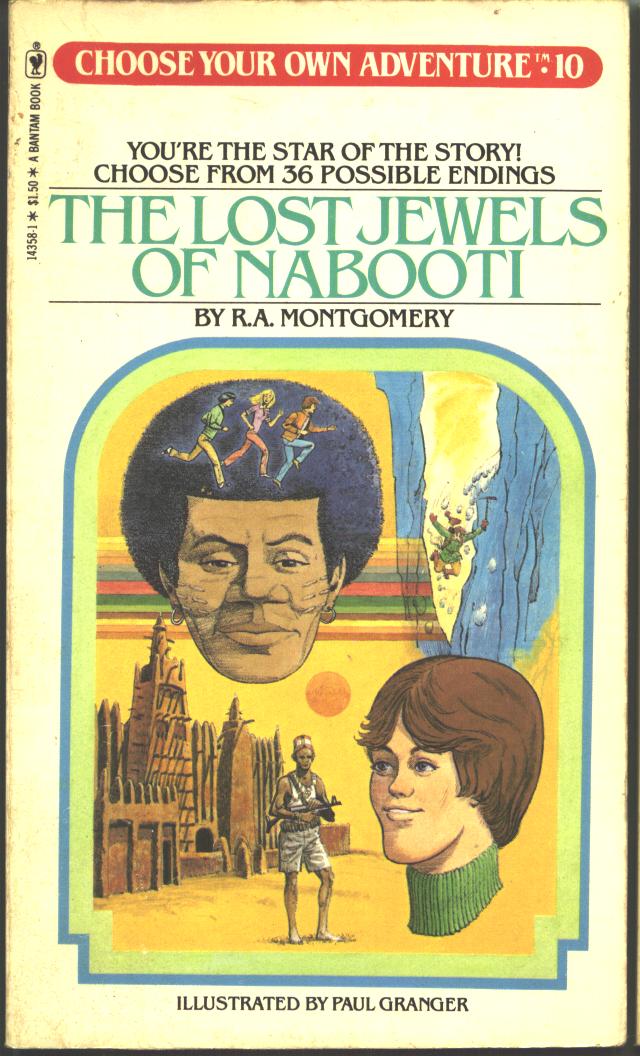
I think you can understand my concern.

Clearly, there was only one thing to do: for my sanity, for your safety, I had to read the thing.

“But Doyce,” (you ask), “how can you have made this sacrifice for us? The book doesn’t come out until November 26, 2010.”

Obviously, I am a time tra–

Err. No, wait. You don’t know about that yet. Paradox. Right.

Obviously, I used my many nefarious contacts within the underworld and put out the word that I needed a copy of the book a few weeks earlier than the unwashed masses. I was eventually put in contact with De Knippling, one of the authors, and we met for some unpronounceable yet delicious coffee in her home town.

“Your city,” I said. “Nice place.”

“Err,” she replied, “thanks.”

“Be a shame if anything… happened to it,” I cliched.

“”Umm…” She raised an eyebrow in my direction, obviously to conceal her trembling fear. “Dude, do you want the arc or not?”

“SUBMIT TO MY COERCION.”

“Whatever.”

Conversion is Complete

Following that exchange (or one almost exactly like it in all ways except the actual words spoken, and the location, and the coffee), I set in to ‘read’ this ‘book’.

I died. Then some other stuff happened. Huh. Cool.

I read it again.

Dead. Some entirely different stuff happened. Heh. Funny.

Again.

Dead. (A hippo?!? What the hell?)

And again.

Dead… and this time I felt the slightest tug of… sadness? Was that a real moment of touching humanity there? Why yes, yes it was.

People, I’m horrified.

You know what the authors have done with this thing?

They’ve destroyed a (literally) life-long prejudice; my well-considered and heartfelt disdain lies dead and mouldering while a category of books that died in the mid 1980s shambles upright and stumbles back into the light. Worse, they’ve taught this unholy creature about humor and pacing and suspense and the tragedy and joy of the human condition. They made it good.

That’s what Choose Your Doom: Zombie Apocalypse is: it’s good.

I wanted it to be bad. I needed it to be bad so that I could continue to cling to my childhood, but this book denied me — it pulled my tattered copy of Inside UFO 54-40 out of my hands and turned my eyes toward the light.

Then it ate my brains.

I suggest you check this thing out. Sincerely. It’s fun romp, a number of entertaining yarns, some surprising depth and (if you know the authors) unsurprising humor, and I think most of the people I know will like it.

And don’t worry about the way it makes your eyeballs itch; the infection only burns for the first few minutes, and zombies are always more effective as a horde.

Tweets for the week of 2010-11-14

  • Morning, #nanowrimo folken. It's day eight. Are you still in this thing? Awesome! Find out why: http://bit.ly/ccmmYM #
  • Listen, internet: I'm kinda tired, so can we just assume I ranted about the stupidity of Daylight Savings Time (again), and call it good? #
  • *looks at calendar* Day seven? Not day eight? *mutters* #
  • Reading a sekrit copy of Choose Your Doom: Zombie Apocalypse. Heh. heheheheheh. Heh. Review soon. http://bit.ly/9fOSue #
  • (Re)Blogged for #nanowrimo folks: Getting past the Dreaded Day Seven: http://bit.ly/ccmmYM #
  • RT @ChuckWendig: Come, novelists and writer-types. Murder unicorns with me. Get shut of writing myths: http://bit.ly/bEYK7P #NaNoWriMo #
  • The cunningly sophisticated @maureenjohnson is answering #nanowrimo questions today. Probably yours. Check it: http://bit.ly/b5UVdJ #
  • Unicorn City trailer: http://t.co/K9o4qtw @unicorncity — I'm in some kind of shameful nerd love with this thing. #
  • I'm unreasonably optimist that maybe, sometime today, Twitter's API will unclench enough for my new blog post links to actually show up. #
  • I'm unreasonably optimistic that maybe, sometime today, Twitter's API will unclench enough for my new blog post links to actually show up #
  • Alright, screw optimism; time to post links my hand. #primate #
  • RT @Three_Star_Dave: RT @pourmecoffee: Pressure building on GOP to cut deficit/create jobs. I sense an anti flag-burning amendment coming! #
  • Writers, gamers, Chuck speaks, and it's good: Solve for X – A Story Must be an Incomplete Equation: http://bit.ly/dBuQtN #nanowrimo #
  • The siding repair guy is FINALLY going to fix our house damage tomorrow. SO, DENVER PEOPLE: It *will* snow tonight. Thought you should know. #
  • Huh. A way to tweet right from the Chrome address bar. http://www.scottporad.com/2010/01/07/how-to-tweet-directly-from-chrome-or-firefox/ #
  • For the Burning Wheel game, @cyface has given his character the Instinct "Always be the Smarted Person in the Room." *rubs hands together* #
  • Gah. Yesterday, none of the twitterfeed stuff worked. Now it's all posting twice. Sorry for the spam, guys. #
  • Surreal: @daphneun had a dream where one of my characters (Vikous) was showering. Leathery wings, pale skin, clawed feet, and sudsy loofah. #
  • As I predicted this morning, frozen precipitation has begun outside my window. How long before the siding guy calls to postpone? #takingbets #
  • I think what might ultimately break my soda habit are afternoons like today, when a meager caffeine dose is INSUFFICIENT. #
  • Who (http://j.mp/cKMQYD) – Who. Pond. Mucha. Lovely. #
  • My new favorite Chrome extension: https://chrome.google.com/extensions/detail/ddkmiidlgnkhnfhigdpadkaamogngkin #
  • First Snow http://flic.kr/p/8SjRaT #
  • Burning Wheel prep and #writing all day today. Need a #nanowrimo post? I suggest this one: http://bit.ly/b18QRW #
  • Tonight's Burning Wheel game involves a murder investigation and a sport we've invented that combines nine-pins, lacrosse, and blood bowl. #
  • Fun first Burning Wheel session. Not the game I expected to run, but I love it. #
  • Should be a very productive morning; absolutely no distra– *email ping* "Your invitation to About.me" — Oh crap. #
  • Least I Could Do: 2010-11-11 (http://j.mp/dsAUup) – This is pretty much how Kate is with dentists. #
  • Someday I'm going to write in the morning when I'm all productive and save sleepy afternoons for crap like fixing web templates. #viceversa #
  • CANNOT. WAKE. UP. Prescription: cold weather and major caffeine hit. Tattered Cover, here I come. #
  • Biweekly veggie/fruit delivery has two pomegranates in it. POMEGRANATES. I don't have that kind of free time; no one does! #
  • Oh dear. It's actually four pomegranates. I'm going to have decide between fruit and finishing this story. #nanowrimo #NaPoEaMo #fight #
  • Hey, @ChuckWendig has some damn good, damn solid tips on avoiding distractions and focusing. Read em: http://bit.ly/d6MVbI #nanowrimo #
  • Least I Could Do: 2010-11-12 (http://j.mp/btTRkF) – Again, this is eerily familiar. #
  • Cunning plan to get some writing done this morning was a complete failure — except for the blog post, which I already do in the morning. #
  • Time to find out if the afternoon will be any better. Netbook says it's got 3 hours of battery left. LET'S FIND OUT. #
  • DAMN this renovation. Damn. it. Why can't anything be simple? #
  • Kaylee has approximately every shade of (or colorwheel neighbor to) "red" on this morning, simultaneously. *fumbles for sunglasses* #
  • The Man in the Frey Flannel Suit (http://j.mp/amLs9B) – Frey's an ass. Notoriously so. #
  • Holy crap. 70k into the WIP, and I just figured out WHY this one thing keeps happening in the story. So surprised. Happy. #lovemyjob #

Linkin Park sings about Writing, Publishing

(Not really, but this song’s been my personal anthem/cattleprod, so y’all get to see it.)

I am not
a pattern to be followed.
The pill that I’m on
is a tough one to swallow.

I’m not a criminal
not a role model.
Not a born leader
I’m a tough act to follow.

I am not
the fortune and the fame.
Nor the same person telling you
to forfeit the game.

I came in the ring
like a dog on a chain.
And I found out the underbelly’s
sicker than it seems.

And it seems ugly.
But it can get worse.
‘Cause even a blueprint
is a gift and a curse.

‘Cause once you got a theory
of how the thing works
Everybody wants the next thing
to be just like the first.

And I’m not a robot.
I’m not a monkey.
I will not dance
even if the beat’s funky.

Opposite of lazy
far from a punk
Ya’ll ought to stop talking
start trying to catch up, motherfucker.

-Linkin Park, When they Come for Me

No commentary today; I’ve got a lot of work to do.

Still, a question: A Thousand Suns has been my touchstone album this November. How about you?

The Life of a Furtive Writer

You know what’s a funny sounding word, no matter what the context? Furtive.

Furtive. Furrtive. FURTive. FURT. Heh.

Yeah. I’m twelve.

ANYWAY. Over on terribleminds, Chuck dropped some great advice on how he fights the distraction monkey of himself. As I mentioned yesterday, we are our own worst enemy when it comes to getting anything done, and Chuck takes my vague directives and supplants them with some concrete-solid examples of what focus looks like. I totally recommend you go read it.

Okay? All caught up? Good.

Now, Chuck’s post is awesome for a number of reasons; the most valuable bit of advice is simply that we need to trick ourselves into paying attention. It might be as simple as putting “the internet” on another computer from the one you’re doing your writing on, or in another room. It might be something like Scrivener’s “writing mode” or WriteMonkey’s… umm… entire interface — that blanks out the rest of the screen and reduces the chance you’ll be distracted. Those are all good tricks.

There’s only one problem, and it’s a relatively tiny one: Chuck’s a full-time writer — man’s a pro (in more ways than one) and as such, there’s the teensiest possibility that some of his tricks aren’t things a part-time writer will find applicable.

So let’s go through the day of a Furtive Writer and add a few things to Chuck’s list of focus-tricks.

Morning

Wake up 30 minutes before you need to be at work. Snoozebar got a workout this morning, didn’t it? Send spousal unit to get The Child dressed, and throw yourself into the bathroom, shower, and closet, hopefully in that order.

Thank god for Oatmeal Squares.

Arrive at work only five minutes late.

Check email for all your accounts (work and personal). Catch up on Twitter and Newsreader. Do work stuff. Maybe get 300 words down in a 15 minute sprint, but probably not.

Lunch

Go back out to your car, hit the nearest drive-through or pull out your brownbag and wolf a sandwich and soda. This leaves you 45 minutes. Pull out your laptop and get typing. You should be able to get roughly 650 words out in this time, assuming you don’t fuck around. Don’t fuck around.

If there’s some kind of wifi near where your car is parked, hook up to it ONLY in the last five minutes of your lunch break — just long enough to save your WIP and let Dropbox sync.

Back to the office. If you were using your work laptop to do your writing (not recommended if you have any alternative), reconnect it to the network and let Dropbox sync up.

Afternoon

During your entirely legitimate 15 minute afternoon break, knock out another 215 words. Otherwise, use your time-wasting allotment to look up stuff you needed to know at lunch, but couldn’t look up then.

After work

Pick up The Child. Arrive home. Make supper.

If you’re a super-parent, do nothing but hang out with the child until bedtime.

If you’re a pretty-good-to-all-right parent, alternate between some quality child/spouse time and pasting that stuff you looked up this afternoon into the spots in your WIP where you left text like [GDP OF SLOVAKIA HERE]. This will add about 100 words.

If you’re going to make up for some bad parenting at Christmas, drop your kid in front of Backyardigans, hand them a sandwich, and disappear til bedtime.

The Child’s Bedtime

Read to your kid. Steal ideas from their chapter book.

Blessed Silence of Night

You have gotten anywhere from 600 to 1300 words down. Assume it’s 600. Also assume you want about 2000 for the day, so you need about 1400. That’s two 700 word (roughly 3-page) scenes. Get to work. If you’re lucky and the words are flowing, you’ll be done by about 10 pm. If you aren’t, you’ll be done around 12:30 am.

1 am

Stagger to bed. Set the alarm for an hour before you have to get ready for work, so you can get some writing in. (This will never work, but it can’t hurt to try.)

GOTO: MORNING

Sound familiar? I expect it does.

So here’s a few extra tips I’d suggest.

Good Batteries

Make sure whatever laptop you’re using has them. Nothing sucks more than really getting on a roll and having your laptop go dead.

Good WiFi

This seems really counterintuitive, but you probably want to make sure that any ‘out of the house’ writing you do is somewhere with a decent internet connection. You don’t want to have it on all the time, but WHEN you need it, you want it to connect easily, quickly, painlessly, and you want it to be super-snappy-fast.

Why?

Simple: if it fails to be any of those things, you will fuck around with it, which will waste a lot of  time. A lot. I’m just saying.

Good Notebook

Have analog means of writing available. Sometimes the laptop isn’t an option. Sometimes you just want to write something down for later. Sometimes you’re someplace where people will look over your shoulder at your screen, but would never DREAM of looking at your longhand notes — society is a weird like that.

Back up early and often
I use Dropbox. Use whatever you want, so long as you use something. This is not. fucking. optional.

Don’t bring an external mouse with you

The harder it is to use your laptop to browse the internet, play Farmville or Torchlight, or scroll back to correct your previous work, the more likely you are to focus on writing. You. Keyboard. Screen. That’s it.

Personally, I do almost all of my writing on my little “triple e” — a netbook I bought awhile back as an award for meeting a tough goal. It’s comfortable to type on for long periods, has about a six to seven hour battery life for writing purposes, and when I combine it with a Logitech lapdesk, I can use it damn near anywhere (I mention this because the netbook itself is too small and too top heavy to really ‘work’ on your lap for more than the most desultory use, in my opinion). The netbook technically has all the same distractions available to it as my desktop (which, if I’m honest, is 90% a gaming rig), but they aren’t as easily accessible, aren’t as fun to use on the netbook, and generally just aren’t worth the effort — I don’t even like using my newsreader on the smallish screen. When I sit down with the netbook, I’m working; one keystroke disables the wifi, another opens either Word (for revisions) or WriteMonkey (for first drafts), a third shuts down my touchpad (so I don’t do something stupid by accident) and off I go.

For whatever reason, I’m shit at writing in the morning — I seem to have engineered my life so that interruptions occur in the A.M. — even when I try to get shut of distractions before lunch, stuff just happens that I HAVE to deal with. I’d RATHER write in the morning, and maybe eventually I will shift things around so it’s possible, but right now? No. That’s me. Your mileage may vary.

How about you? What tricks do you use to leave yourself NO OPTION but to write? Give me something I can steal.

Your Own Worst Enemy

Early this month in the comments for “the Gazebo post”, I wrote:

I’m definitely in the camp that believes you have to be the greatest defender of your time.

Sometimes, you need to defend your time from yourself.

I want to dig into this in a little more depth.

“Time Management” is the sort of catch-phrase that makes people nod along when it’s mentioned and roll their eyes when no one’s looking. Books like First Things First and Getting Things Done are often quoted, rarely read, and even more rarely put into use. (Or, if they are, they become a ritual of masturbatory to-do-list-maintenance that doesn’t actually accomplish anything but which looks and feels like you’re doing something. Productivity Porn, is what it is.)

Now, I read those books because part of my day job involves taking high-concept crap like that and boiling it down for blue-collar guys who need to know it. The end result of all that reading was a two-hour class during which the students get a blank pocket notebook and a double-sided business card on which I printed the entire ‘manual’ for the class.

About two years after I started teaching that class (and generally adopted its methods for myself), my wife came to me ‘in an emotional state’, as they say.

If you don’t know, Kate runs a pretty successful literary agency, specializing in YA and middle grade fiction. She does a great job, but she was starting to feel like some things were getting away from her: emails were backing up, for example.

She asked me if I could help.

So I showed her my little business-card manual, and gave her the gist of the thing.

“That’s it?” she said. She looked doubtful, but muttered something about giving it a try.

Months later, she’s so caught up on her work that she gets private emails from other agents and editors that say “I don’t know how you do it! I can barely find the time have a nervous breakdown anymore, let alone keep up with actual work.”

So… just for fun, let’s say the little system works. Let me give you the absolute basics.

The crystalline core of the thing focuses on Doing, because we as a species suck at Doing. Between people interrupting us and babbling away with no provocation, reminders from our email and calendar, our phones, Twitter, IM clients, facebook, Tumblr, new readers, and… you know… a life, it’s just hard to block out some uninterrupted time and then actually use it for whatever task it was intended to be used for.

So we try solve that problem by doing two things at the same time: Checking Twitter while visiting with family. Emailing while making lunch. Writing while doing… anything else.

I’m mentioned before that there are very few activities during which I’ll multi-task; I think the list starts and ends with “folding laundry while watching a TV show”. Pretty much anything in my life that I think is important enough to do, I believe is important enough to get my full attention. When that doesn’t happen, the end result of the two ‘intermixed’ activities is usually substandard. In fact, every single activity you try to do while also dealing with some other activity will probably suck, even if you don’t notice it right away.

You must avoid doing that.

That means focus.

So, here’s a few rules I (try to) follow to help me DO during those times I have allocated for Doing.

1. Focus on one task at a time.

This single-minded focus doesn’t have to go on for hours at a time. If you get on a writing streak then sure, go for it, but it doesn’t have to be that way. Do 30 minute sprints. Do 20 minutes. Do 10. Whatever works.

Eliminate all distractions. Shut off Twitter, Gmail, YIM, AIM, GTalk. Close your door, if you can. Make sure the cat, dog, kids, spouse, and coworkers are all are fed, then ignore them.

Don’t multi-task, and don’t let yourself get interrupted.

2. Seriously, don’t #*$#ing Multitask.

The supposed efficiency of multitasking is an illusion — it hurts your productivity, increases the chance of error, and generally makes the end product suck more than it should. It’s a good way to avoid two things you don’t really want to do by fucking them up simultaneously. Don’t do it.

The human brain is amazing in many many ways, but it positively sucks at concentrating on two things at once. As soon as you try, you can guarantee you’ll miss something important.

3. Control Who Has Access to You

“Timmy, Daddy needs some alone time right now, okay?”

Stop and think about something for a second: who has unrestricted access to you at virtually any time?

The answer to that question says a lot about who you are.

I set my GTalk Status as Busy most of the time because I know that there are very few people who will be comfortable sending me an instant message anyway (provided they feel they have a good reason). The people that know me well enough to ignore that message are the people on my All-Access list.

If you don’t control this, you’ll be typing along, just getting into a groove, and someone will ping you. You need to answer, right? You don’t want to be rude.

So you answer, and they need you to do something for them, and… well… you don’t want to, but pretty soon you hear yourself saying:

… and you’re screwed.

4. No one else gives a crap if you Finish.

No.

No they don’t.

Not even him. Not her either. No one.

Not even me; I’m distracting you RIGHT NOW with this post.

You are the only person who cares about getting your story done, and the only way to make that happen is to viciously (perhaps anti-socially) defend the blocks of time you set up to write.

“Sorry dude, but I’ve got another two pages to get done.”

You must do this, even if the interruption sounds like fun.

You must be cruel, even to yourself.

You Can Break Every Rule

There are a lot of rules when it comes to writing. Writers love to scribble down mandates like “don’t do this” or “always do this” and pretend that we’ve solved part of the vast jigsaw puzzle of creativity.

But the thing is this: pretty much every one of those rules can be broken or ignored, if you have a good reason for it.

I want to be clear, here: I think most rules about writing are good rules, and are valuable. “Try to leave out the part of the story that the reader’s going to skip.” That’s a good rule.

But, like most things, if you get good enough at the work, you’ll run into some situation where the rules you love are not only inapplicable, they will actually make the situation worse if you adhere to them.

(Warning: If you are at all unsure you’re qualified to decide whether or not to ignore a rule, I would like to humbly suggest that you aren’t. You will know when you’ve reached that point, without checking with anyone else first. Until then, stick with the rules. I know how pretentious this sounds. Please trust that I don’t mean it that way.)

This is why I tell people not to listen to the advice I have about writing (as opposed to NaNoWriMo): when it comes to writing, I’m going to automatically assume that I’m unqualified to give advice; I’m not an expert yet.

Let me demonstrate that by poking holes in the rules I’ve mentioned here in the past.

When you’re writing, write.

The basic idea here is that when you sit down to write, you must get some words out on the page — you should be producing, not wasting time — the first million words that you write are going to be glittery unicorn shit anyway, so you might as well get them out of the way as fast as you can.

That’s not entirely true. If you sit down like that every single morning at eight o’clock, you’ll develop your work/write habit, yeah, but there’s a tendency when you’re in that mindset to approach the whole thing in a very rational frame of mine, and we aren’t any of us very rational people. If you’re in that kind of frame of mind, and you get stuck, you’re going to give up on writing for that day in about fifteen minutes.

So sometimes when you sit down to write… you don’t write. You woolgather. You shut the fuck up and listen to the echoes in the empty spaces of your head, because those echoes are coming from somewhere — some whispers and hints and intuitions that are sneaking around just past the corner of your eye, and you need to lie still to trick them into the light. Do that. It’s okay.

Rules of Three

The basic idea here is to describe everything in your story by using three facts only. A good guideline, yes, but be ready to cast it aside when you need to. Maybe (like me) you never describe the physical characteristics of your main characters for the entire length of the story — the readers never find out if her hair is auburn or blonde, kinky or straight; what kind of shoes she likes, or what color her jacket, eyes, fingernail polish, or lip gloss are. If that’s the right thing to do for you, then go for it. On the flip slide, maybe you feel a pressing need to describe one particular character in your story in absolutely excruciating detail. Will anyone remember all that stuff? Hell no, but if you’re dishing that kind of detail, then the detail itself really isn’t the point; maybe it’s telling us something about how obsessed the observer is, or how fastidious the subject is, or… I dunno. I’m not you: I don’t know why you decided to drop a microscope on this guy, but if you did so, there’s probably a good reason for it, besides needing to bloat up your word count.

Right?

“Any word you have to look up in the thesaurus is the wrong word.” — Stephen King

I’m a big fan of this rule, but it’s one that attracts a lot of flak. Non-writers often comment with something like “But… what if I actually pick exactly the right word? Are you saying I’m stupid? Are you saying the thesaurus is always wrong?” Writers, on the other hand, can almost always trot out some example where they’re writing a character with a particular kind of vocabulary: someone who would never say shit when they can say excreta. Yes, fine: you’ve nitpicked the particulars of the statement to death; you win the Internet again. Go you.

They kind of miss the point of the statement, which (taken in context) is simply that you should write with the language and vocabulary that you have immediately to hand; the tools with the most worn and comfortable grips. Writing with those words helps you sound exactly like yourself on the page, and that helps your story’s authenticity and honesty. It helps the story be true, at least in the sense of a realization, if not as an actual fact. Taken in context, it’s a very nice rule.

And, of course, there are times when you should — when you must — ignore it. Aside from anything else, you will grow as a writer/reader, and your vocabulary will expand, and what was once a thesaurus-word may become a you-word. Even then, sometimes the word you need — the perfect word — will be a word only found in a thesaurus.

(I’m still suspicious of perfect words: perfect things are rarely true things, and true things are rarely perfect, and on the whole I’d rather be true than perfect, but I’ll leave that navel-gazing alone in this case.)

Kill Every Adverb

Oh… man. I dunno. This one is tough. I like this rule. This is a good rule. Adverbs are largely useless, lazy, slugabed motherfuckers and I won’t have anything to do with em.

But sometimes…

Sometimes… an adverb is just the right way to say it.

Sometimes. Yes. Fine.

God that hurt to write. Ouch.

Some Things Are Not Rules You Ignore

There’s a difference between rules and tools. Rules are the things I mentioned up above. We will learn when to ignore those, just as we’ll learn that most of the time we shouldn’t.

Tools are something different. Tools are things like spelling. Grammar. Punctuation. Tools require respect. You don’t paint your house with a screwdriver; you don’t frame a wall without your hammer.

Create whatever you want to create, but build the fucking thing correctly, is what I’m saying.

Leave the AWOL punctuation and a weird aversion to quotation marks to guys like Cormac McCarthy or Charles Frazier. On anyone else (and, in fact, even on them) it looks like pretentious fuckery, and that’s all I have to say about that.

Now, I need to get back to the woolgathering.

You: get back to work. Have fun.

I am like some kind of genius at predicting stupidity

Twenty days ago, in this post, I made a prediction:

At least one — probably several — big publishers will try to introduce their own ebook reader or ebook format, despite the fact that popular formats exist and are already being whittled down to a few survivors. These things will suck huge amounts of money that could have been spent partnering with existing solution providers and solving the problem with already-adopted tech.

WELCOME TO THE FUTURE.

Check this bit of brilliance out:

Houghton Mifflin Harcourt announced a tabletish color ereader targeted at children in mid-2011. Called the Fable, the seven-inch touchscreen device will sell for between $149 and $179 (plus cellular connection fees). “Several” HMH books will be pre-loaded on the device, and Isabella ceo Matthew Growley says they “have right now four other publishers signed up,” though he would not name them. (That implies, but does not state, that the company is thinking of a proprietary store and/or format.) The device will be sold from their own website and “select retailers.”

Nook Color notwithstanding, HMH svp of digital strategy and planning Cheryl Cramer Toto says “there is a real market need out there for a kids’ color tablet.”

In other device news, E Ink [Doyce: the technology that Kindle uses] is unveiling their first color electronic paper display at a trade show in Tokyo today.

Tomorrow, Ford will announce a product called an “fTire” that will, in the words of one insider, “reinvent the wheel”.

Jesus wept.

People: Kids books make up twenty-five percent of Kindle sales. It’s the fastest growing category for Kindle. I needn’t mention what percentage of all ebook sales Kindle and Nook represent.

Can someone else compete with Kindle? Yes. Can someone build a better, cheaper ereader than Kindle? Yes.

But you know who won’t?

Publishers. Building the next great electronic gadget is not what they do. It is, in fact, one of the best examples of Not What They Do.

Okay, I’m done ranting. I’ll wrap up with another prediction. Here we go:

This isn’t over. At least one other publisher will announce some similar project in the near future.

(Because why just compete with Kindle when you can compete with each other as well? *headdesk*)

Stuff that Helps that I used to Hate (#nanowrimo)

1. Write-ins

I’ve never been a fan of meeting new people. That’s an odd thing for an undeniable extrovert to say, but it’s true: walking up to a crowd of unfamiliar faces that all turn toward you with a blank lack of recognition? Not my favorite activity ever.

That reluctance kept me away from NaNoWriMo write-ins for many years.

The other thing that kept me away? The part where you go to a gathering of nanowrimo folks and don’t end up getting one fucking word written. Not really surprising, when you think about it: take a bunch of people who are working on a brand-new, shiny story, sit them all down with readily available caffeine, and watch them (us) turn into cute little chatty hunks of non-productivity.

That was my experience with write-ins for the first couple years I showed up. It got to the point where I didn’t go unless I was ahead on my word count for the day, and since I’m almost never ahead on my word count… well, you see where this is going.

Saturday was different, though. Saturday, after a long day in a long class, I decided to drop in at a local write-in to clear my head.

It won’t help me get caught up, I thought, but at least I’ll get a free nanowrimo monkey sticker out of it.

I showed up about an hour after it’d gotten started at the local bookstore (Tattered Cover), snagged a frozen latte, and walked over to the circle of couches and comfy chairs where our particular nerd herd tends to assemble.

Good turn out. Lots of folks, most of whom I didn’t recognize.

No one looked up.

I mean it: no one. Hands on the keyboards, butts in the chairs, eyes on the screen, tappity tap.

Damn, I thought. I found a chair, pulled out the writing machine, and got to it.

About fifteen minutes later, everyone suddenly looked up, blinked, and started chatting. Some got up to snag another coffee or hit the head. I looked around for the professional hypnotist. Folks compared word counts, chatted about disobedient main characters, compared their laptops and recommended writing software they liked. The local ML came over and hooked me up with my monkey sticker.

This… this was the nanowrimo write-in I knew; the one I expected.

About twenty minutes later, though, it all came to a stop again. Everyone was back, everyone got settled, and the ML said “Okay, are we ready for another sprint?” There was a general murmured agreement.

A gah what-now? I thought. The only time I heard that phrase was when I’d used Write or Die in the past.

“How long are we going this time?” she asked the group. “A little shorter? Fifteen?”

Again, agreement. She set a time on her laptop, tapped a key, and said “Go.”

They went. We went. Boom. Writing. Heads down, fingers going. Focused.

I may not know much about how the writer-brain works, but I’ll tell you one thing that’s pretty consistent: it responds to deadlines. It responds especially well to looming deadlines.

I take back everything I ever said about the write-ins. Maybe the (excellent) MLs in Denver are the only ones to figure this little trick out, but maybe not — and if not, I have to recommend dropping by a write-in in your area. Socializing with the other nanowrimo crazies is always a good thing in the long run, but now it’s something else: now it helps.

2. Twitter

Now, I like twitter, but I don’t love the easily available distraction it provides when you need to get some writing done, so what changed my mind? Two things.

2a. The #nanowrimo hashtag

If you need a little inspiration, I humbly recommend checking out the #nanowrimo hashtag on twitter. For one thing, it’s really kind of neat to see all these excited and creative people talking about what they’re working on, but it also really encourages to you to get your butt in a chair and write.

How does it do that? The same way that seeing a guy you really don’t with an “I Voted” sticker on his shirt will get you to the Ballot Booth — all it takes is about four tweets where some rat bastard is all like “Just broke 30k on my #nanowrimo WIP” to get me back in my chair. Shame and Resentment, baby: that’s what makes the world go ’round.

Yeah, yeah: “shared creative energy” blah blah blah… sure. Whatever. Bottom line? We wanna beat that other dude.

2b. NaNoWordSprints

I hadn’t heard about NaNoWordSprints until a few days ago, and I highly recommend it if you can’t make a write-in but still want that feeling of someone firing off a starting gun and saying “Go!” It’s like a write-in for shut-ins. It seems to be something semi-official being done by the NaNoWriMo folks. Check it out. Make Twitter actually help you out this year.

Here’s the Thing

Marathons are hard; even people who run them all the time know they’re hard. People who do them for fun are a) crazy and b) actually running a more difficult race than the ‘regulars’ are, because they probably trained less, run less, and may not really know what they’re getting themselves into. They show up for the race and the veteran runners are like:

This NaNoWriMo thing is the same kind of deal. As De points out, professional authors like to say they they do NaNoWriMo every month and while that’s a cute answer, it’s not – strictly speaking – true. Yeah, they’ll often knock out 50k in a month, but for most everyone doing NaNoWriMo, it’s not just about getting the word count, it’s about getting the word count while holding down another full time job, filling out TPS reports, getting the kids to school, taking care of all the things that need to be done around the house, and all that.

Have help. Make friends. Connect with the folks who are running this crazy-ass race with you — who also don’t know really know what they’re in for. The whole thing may drive you crazy, but at least you’ll have company.


(Personal hurrah: Hidden Things is heading back out to publishers today to see who salutes. I am pleased. Agent Shana is pleased. Even some of the editors getting it are pleased. A good way to start the day. I took a look at an old copy of Hidden Things this weekend — the version that I actually queried with several years ago — it’s approximately 68% the size of the current manuscript, and even that version was a far different animal than the very first NaNoWriMo copy. I will throat punch anyone who tells me their NaNoWriMo story is ready for publication as of December 1st. I will do so jovially, but still: throat punch.)