Vayland Rd. [1] – The Call

[What follows is the first part of a short story I’m working on revising. The rest will follow over the next however-many-days-it-takes. I might put some editing notes in the posts’ comments. If you’re looking for such things, look for them there.]

Vayland Rd.

I remember, when I was a kid, riding in a car with green, leathery seats that got very hot in the sun. The car was green as well, although a different shade, and it seems to the me of my memories that most of the cars back then were that color. It was a popular trend, or maybe my child perception was skewed.

At any rate, the car was green, the seats were green, it was summer, the sun was hot, and the seats were hotter. We had the windows open to let the air in and my mom was driving to town on an errand.

The road was a winding black hardtop that looked down into sharp ravines between the hills; drops that seemed (to me) to go down and down farther than anything in the whole world. Every drive, I would look down and out from the tiny back windows of the two-door and think about what it would be like to go sailing off the road and into the ravines, tumbling over and over and finally exploding at the bottom, like on TV. A little morbid, but we lived a long way from any other kids my age — I had to make my own fun.

So, with the sun beating down and my boredom rising, when I saw a goblin shambling along the bottom of a ravine with an old, rusted sword balanced across his shoulders like the yoke of a wagon, I didn’t bother mentioning it to my mom. Even at that age, I assumed I’d imagined it.

I believed that for the next 23 years.

—-

~ The Call ~

My cell phone rang while I stood in line for lunch, the screen showing OUT OF AREA instead of a number. I thumbed it open to stop it from ringing and muttered a terse “This is Sean” into the mouthpiece, which usually clears up wrong numbers in a —

“Hey bud, how’re you doing?” My mom was only person in the world that called me ‘bud’, a lukewarm leftover from my preteen years that she tended to drag back out when she was feeling down.

“Hey, I’m good. What’s up? Something wrong?”

“Oh, you know…” Her voice wavered a little bit. A bad sound. I stepped out of line and headed for the door. “Been a little crazy here the last couple days.”

“What’s going on?” I didn’t try to keep the frown out of my voice; it wouldn’t make her feel any better if I did.

“Well, we can’t seem to track down your dad.”

I stepped into the watery sunlight and pressed the phone against my ear to block the white noise from passing traffic. “I lost you for a second. You can’t track down Dad’s what?”

“No, we can’t find him.” I heard her set something metal down on something solid. She was wandering around her kitchen, fiddling with things. It was a Tuesday. She wasn’t at work. “It’s been two days.” She paused. “Or four, I guess. Three and a half.”

I scowled at the pavement. “I don’t understand what you’re telling me. Is he traveling?”

“No, he’s been home for a couple weeks.”

“Did… what happened? Did you get in a fight or something?” It sounded surreal even as I said it.

No, of course not.” She, the properly-raised Midwestern wife, sounded vaguely insulted by the idea. “I went to bed a few nights ago and your dad stayed up watching TV. When I got up he wasn’t there. I thought he’d gone out to get some work done before it got hot.” I heard her move something else across the counter. “But he wasn’t.” Her voice crumbled, and she took a breath that sounded like a series of tiny gasps – the kind you hear little kids make between knee-scrape sobs.

She sniffed into the phone. “You still there?”

“What? Yeah.” I shook my head. “Quit… quit moving things while you’re on the phone — you can never find them later.”

“Okay.” Her voice was small and sounded further away than it should.

I let my eyes move from the sidewalk to the sky. “I’ll be there tomorrow afternoon.”

“Are you sure?” She sniffed again. “I know it’s a long ways.”

“Yes.” I made sure not to hesitate, but let my answer stand for both of her statements.

“Okay. Where should we pick you up?”

I started down the street, heading for the back parking lot. “You won’t, I’m driving out.”

“Oh honey, you can’t.”

“It’s the only way I can,” I replied, unable to keep the tightness out of my voice.

“It’s such a long ways.”

I checked my watch. “I need to get moving if I’m going to make this happen today. Okay?”

“Okay.” She’d given up arguing, which told me more about how bad it was.

“Call me if you find anything out. Be careful,” I finished, and ended the conversation wondering why I’d said it.

Several hours later, filling overnight bag and leaving messages with various people about an unspecified family emergency, I still didn’t know.

The Wonderful Stink of Revision

Did you read it?

No, not yesterday’s post; did you read something of yours? How was it?

Don’t tell me you’re not done reading it yet; you were supposed to pick something short.

And don’t tell me you didn’t have time; that’s your lack-of-grooveness talking. Make time. Read it while your significant other is doing a frame-by-frame live Tweeting of Lost or something. Time enough to accomplish The Reading exists, it’s just in the wrong box right now. Go get it.

So whadja think?

Needs some work, dunnit?

Good.

You’re gonna revise that sucker.

I know, I know: you’re out of the Groove. I’m saying “You need to revise,” and you’re all like:

...
...

Keep it simple. Have some clear technical goals in mind.

  • Find the spots where the story doesn’t seem to go into a scene long enough or far enough. Take it the rest of the way.
  • Fine the spots where your voice is muddied and indistinct. Clarify it. Clean things up. This is probably something you wrote awhile back, and you’ve learned stuff since then, so make use of it.
  • Kill adverbs. Rewrite the sentence so that you’re saying the same thing with better words.
  • The one scene that doesn’t seem to do anything? Take it out. This is your acid test revision: no less than 10% of the original text should hit the cutting room floor.

That’s the official list of goals.

But what you’re really doing is getting down in the muck, up to the neck, in your own writing. In you. Wallowing in the glory of your own wonderful stink.

That is your method, and it’s also your true purpose in this little endeavor. Yes, doing the revision will be nice, but your real goal here is to remind yourself why you like playing with words, and what all your favorite toys feel like.

Wallow. Get the mud in deep. Oink oink.

As a show of solidarity, I’m going to do a little public wallowing for the next week or so. My particular mud bath will be a short story I wrote a few years back called Vayland Rd. It’s a peculiar little thing I wrote as part of a 24-hour blogathon, so it’s about 7 tenths inspiration and 5 eighths exhaustion, but it came from a good place, I like the characters, and the story’s important to me.

As I revise, I’ll post a chunk of the yarn up here every day, so you all get something to read in between your own wallow sessions. Sound good?

Hope so, cuz it’s the best deal you’re gonna get.

Now get back to your wallowing.

Oink.

Getting back in the Groove: Reading your Favorite Writer

So it’s been awhile.

You had a good end of the year writing rush. You got your edits done and off to your writing group, your first readers, your second readers, your volunteer editing harem, maybe even your agent. You started a new project and lo and behold, THAT went well too.

Then the holidays snuck up behind you and kicked you in the spine.

Maybe there was travel. Gifts. Food. Possibly drink. More travel. A nasty head cold, some vomiting, and body aches topped off the festivities. Yet more travel.

Then you’re back home, and your day job would like very much if you could make up the time you just spent on the holiday break, without actually clocking any additional hours. Tax paperwork starts coming in. Your cold won’t go away. All those shows that conveniently went on break before the end of the year are back and broadcasting what feels like two new episodes a week and all your friends are talking about them and spoiling everything. The driver’s side windshield wiper starts tearing, your fifty thousand mile checkup is ten thousand miles overdue, and your kid wants to join ballet and karate.

You’re carefully sculpted writing groove caves in like a badly dug trench.

The situation grows more complicated.

Now, please understand, when I mention a Groove, I’m not talking about a muse. I don’t believe in The Muse. A Muse. Whatever. Eff that nonsense right in the ear. Clinging to the ‘inspiration of the muse’ is some delicate, lacey bullshit (there’s a mental image) and I have no patience for it.

But there is such a thing as a groove, it is possible to get knocked out of it, and it can be a fucking drag to get back in there. Without some serious effort, it could take…

Well, honestly, it might never happen on its own.

This will not stand.

The mind-dulling blankness of January has gone by, and it’s time to dig your way back in there. Let the mud fly, people, and don’t worry about who else it hits.

What’s that? No shovel? Must you use your bare hands?

Ye–
Wait.

No. No you don’t. There are tools.

Read

It’s a simple thing to say, but one very pleasant way to make the mud fly is to read. If nothing else, it helps you remember the various cool ways those word things get strung together. Some of what you read will inspire you, some will amaze you, and some of it will, to put it bluntly, make you really really mad that you aren’t making a living as an author right now, because goddamn if you aren’t a hell of a lot better than this guy.

But I don’t need to tell you to read. You’re doing that already.

Right. It’s not the activity that I’m specifically talking about, it’s the author; what I need you to do right now is start reading your very very favorite author of all time.

You.

Now, I know what you’re thinking.

Man you're hard on yourself.

Why waste precious reading time on boring old you? Pay attention: you’ve been out of your groove for awhile, and while it’s great to read other fantastic and not-so-fantastic authors, it’s more important right now to remember your own voice.

Cuz you’ve kind of forgotten.

Which makes it really hard to jump back in and pick up where you left off.

So find something of yours. Doesn’t have to be super-polished. Doesn’t even have to be good. Probably shouldn’t really be that long, either.

Read it. Listen to that writer. See how they string the word things together. Get inspired by it, get amazed by it, and get angry at how much better you can do.

Let all the good and bad of the story soak into your winter-dry brain sponge. Let it percolate.

Tomorrow, you’re going to fix it.

Publishing, Charlotte*, and John*

Today, kids, it’s storytime.

But first (and related to the story), I’m going to revisit the Macmillan/Amazon Weekend Event and talk about publishing in general.

Now, Amazon came out yesterday with a statement about the whole weekend drama llama. Yes, they attempted to paint themselves, disingenuously, as “fighting for the little guy”, and I rolled my eyes, but I was surprised that most of the snickering and snide commentary from the internets was directed at their use of the word “monopoly” when describing Macmillan’s control over their imprints.

I was also kind of disappointed. The people doing the snickering are readers (and writers), and they should understand the meaning of the word well enough to know that it was perfectly apt.

Monopoly: exclusive control or possession of something.

Of course Macmillan has a monopoly on the books produced by their various imprints. It could not be otherwise. It’s not a monopoly in the “Ma Bell” sense, but that wasn’t the sense in which it was being used.

Does Amazon likewise have a monopoly on ebook sales?

Nnnnnnno. Maybe no. Probably not. They do not control ebook sales to the degree that Macmillan controls who gets access to Macmillan books.

But hey: it’s close enough that if someone said “Amazon essentially has a monopoly on ebook sales”, I would not bother to argue, because it’s not worth the effort and gets us nowhere. For the sake of argument, let’s say both Amazon and Macmillan both have “exclusive control or possession of something” that the other one wants some access to.

Ultimately, all that happened this weekend was Macmillan and Amazon fighting over which monopoly interest gets to exert their pricing desires, not whether. And the thing to remember about that is that pricing determined by a monopoly is, generally, never good for the consumer.

So who was I rooting for in that weekend fracas? Please: that’s like betting on a fight between two rabid weasels — I’d prefer they both lose.  Amazon’s just trying to maintain their hold on epublishing and push Kindle sales, and Macmillan won’t earn authors one cent more by forcing Amazon to sell books for $15 bucks (they should, but only if the author has the sense to renegotiate contracts based on the change to the market Macmillan’s trying to push through), and their justification for the ebook pricing is an insult to my intelligence.

Who do I think will ultimately win? In the end, any of the Big Six publishers will probably come out ahead in a game of chicken with Amazon unless technology provides a new model for publishing, because publishers have more leverage as the content provider.

(Really, authors should have the most leverage of all as the true source of content, but that logic only works if authors acted in unison, which… well, come on. The most influential move most of us make in a given day is deciding whether or not wear pants.)

For me, all that this weekend did was remind me how much is broken with regard to the way publishing works.

Writers, whether published or not-quite-yet, please hear this: I need you to think like a reader for a little bit. I know you are readers. I know. Shh. Shut up and bear with me. This isn’t a trick: I’m not going to steal all your royalty checks while your eyes are closed. Just… think like the person who, at the end of the day, finally buys and reads a book.

Because here’s the thing: in the world of paper publishing, publishers don’t give a tin can fuck about you, the reader.

  • In the world of paper publishing, you are not their customer.
  • In the world of paper publishing, the book seller is their customer. This means that it doesn’t matter if you think a book costs too much; it only matters if their customer thinks so.
  • In the world of electronic publishing, you are not the publisher’s customer either. Amazon is their customer. Mac iBook store is their customer.
  • In the world of electronic publishing, you *could* be their direct customer, but in almost all cases, you aren’t.
  • Here’s a dirty little secret: the Big Six don’t really want you to be their customer. If a bunch of people are their customers, there are suddenly all these individuals who ‘want things’ and ‘have opinions’. Right now? There’s a handful of customers to deal with/please/coerce. The current set up is better and easier for publishers.

Please don’t think that I hate publishers for this. They are businesses. This is how the business works right now and, unless the technology available forces a sea change, it is how it will continue to work.

And please don’t think I’m lumping writers in with publishers. Writers (all those I know, and I know quite a few) love readers, even if they aren’t their readers. As I said, they are readers.

So, be that reader for a second. Let me help.

Let me tell you about Charlotte*.

Storytime

Charlotte is one my coworkers. Charlotte loves to read. She doesn’t really read the same kind of stuff that I do, but we still manage to find lots of reader-stuff to talk about, because there’s a kind of commonality two avid readers can usually find.

Right now, Char’s having a pretty rough time. Like a lot of folks, she’s feeling the pinch of the recession: she traded in her much beloved, bright red vehicle for one with lower monthly payments; she and her husband are looking for a more affordable place to live because their current house is proving to be too much of a burden right now. She’s got a injury that she has to go to physical therapy for several times a week.

… and she has to deal with John*.  John is old school. John doesn’t use Outlook’s calendar function – he writes down everything on one of those desktop blotter calendars and insists that be the ‘master calendar’ for his department, and that is just the tip of the iceberg of retrograde thinking that floats around inside his head.

(Note: that isn’t actually the master calendar for his department: every few weeks, someone takes his calendar and “manually syncs” it with the Outlook calendar EVERYONE ELSE uses, thus creating a viable electronic version… which he’ll never ever see. Which, come to that, he doesn’t even understand the need for.)

At Christmas time, Charlotte asked for one thing: a Kindle. As far as I could tell, everyone in her life pretty much chipped in and got it for her. Maybe she got some other things as well, but if so, I didn’t hear about them. She loves that thing, and she uses it constantly. Her lunch breaks are Kindle breaks. Her weekends (thanks to her injury) are pretty much “Kindle and heating pad” days. We’ve talked about Amazon’s DRM on the Kindle a few times, but the bottom line is that it doesn’t really affect her and so long as that continues to be the case, she doesn’t really care.

She just wants to read.

And, I think it’s safe to say, because of the Kindle, she’s buying more books than ever. Any writer would be lucky to have Charlotte as a fan.

Well, maybe.

Not if your ebooks cost fifteen bucks.

See, when I got a chance to talk to Charlotte after all this stuff that happened this weekend, the first thing I asked her about was her purchasing habits with her Kindle, because she’s the only person I know who uses their Kindle in the way in which it was intended. Kate uses one, but she uses it exclusively for work, which means reading partial and full manuscript submissions sent to her by authors. My agent also uses one, but pretty much in the exact same way. As far as I know only Charlotte uses it the way a regular reader does.

And Charlotte doesn’t buy fifteen dollar ebooks. Most of the time (are you listening, Amazon?) Charlotte doesn’t buy ten dollar ebooks. Given a choice between a book listed for five bucks and ten bucks (or the promo stuff available for free), and all other things (quality, subject, reader interest) being equal, she’s just not going to buy the ten dollar book. They’re both books, after all, reasonably well-vetted, and as I’ve said, she just wants to read.

“But,” cries the writer, “if I let Amazon list the book for five dollars (or four, or three, or two), I will make half as much per sale.”

Sure. Yes.

You know how much money you’re going to make from selling that ten (or fifteen) dollar book to Charlotte?

Nothing.

Because she didn’t buy it.

Cheap sells more copies — puts more copies of your story in front of more readers.

And maybe, juuuust maybe, authors should be more concerned with getting their stories to the greatest number of readers, instead of worrying about per-sale payoff.

Maybe publishers should be too, instead of clinging to the old publishing model in which their real business is selling paper.

Stuff I Learned this Weekend

In the postscript to this piece, Eirik Newth India, Ink. explains why Big Publishing consistently cites costs to create ebooks that fall miles outside my experience and expectation.

Short version: they’re doing it wrong.

Long version:

Publishers are still producing paper books the “X-Acto–and–wax” way and then outsourcing their e-book production to other companies, which probably automate the conversion process, and then they’re not practicing any kind of QA on what comes back, because nobody gives a shit, because the people who make the decisions don’t read e-books.

No wonder they think making an ebook is an expensive, time-consuming process.

Yes, you read that right. Publishers aren’t producing workable electronic files when they produce a paper book — their product essentially has to be OCR’d by a third party company to get an ebook out of it. They start with a hardcopy difficult-to-translate template file and make someone else turn it into an electronic version for distribution; a version they’ll never read.

They are, in short, my coworker John.

John’s on a ‘planned retirement’ schedule that concludes in a little over a year.

People are counting. the. days.

Draw whatever parallels from that that you like.

Elephant Fight: the Macmillan-Amazon scorched earth offensive

(Author’s Note: Chuck has a calmer assessment of this situation. I get worked up about this stuff. If that offends, I highly recommend his post.)

All right. Wow. There’s a lot to talk about here.

First, Backstory

Once upon a time, the five major publishers in the country decided they wanted to sell their ebooks for about 15 bucks, give or take. Their reasoning and justifications given for this price point were (and continue to be) insultingly disingenuous; the real reason (in my opinion) I will sum up in this trite opening paragraph as “this new technology scares the holy fuck out of us, and we’d like to erect a price barrier around it to ensure that only wealthy early-adopters make use of it until about 2022, when we hope we will finally understand it.” (I will address their reasons in a more detailed manner below. Promise.)

Amazon took a look at this and decided to sell those books for ten bucks, instead. Given that they still have to pay publishers the same amount as they always did, and still owe the publisher the same percentage of fifteen dollars that they always have, it’s fair (if mildly mathematically inaccurate) to say that, by doing so, they were voluntarily losing 5 bucks on each ebook sale.

(“Losing” is a poor way to say it; they were setting themselves up to make considerably less per sale, but they hardly started hemorrhaging money.)

Why would they do this? Well, they haven’t said why, officially, but there are three main schools of thought on the subject:

  1. If they price the ebooks for less, it will drive consumers to Amazon’s Kindle device. Once a consumer has bought said device, they are pretty much locked into buy ebooks from Amazon into perpetuity, so this reduced price results in a huge net win for Amazon.
  2. Amazon is pricing ebooks at 9.99 to set expectation for ebooks priced a well below the publishers’ 15 dollar target, to eventually use that consumer-groundswell to force publishers to lower their prices permanently.
  3. Amazon is FIGHTING THE MAN, using their corporate power to defend consumers from the greed and tyranny of Big Publishing.

I have listed these theories in descending order of likelihood/connection to reality. (Also, #2 is basically a fake-out: it doesn’t exist without either #1 or #3 as a motivator.)

Full disclosure: I have believed each of these three theories at some point in the past, though I’m currently standing by Theory #1, because (generally speaking) any theory about a corporation that ascribes the least amount of moral compunction and the highest amount of profit-mindedness is probably going to be the most accurate.

What’s the new News everyone’s on about?

Within the last 48 hours or so, all the books (paper or electronic) published by Macmillan or any imprint of Macmillan (Tor, St. Martins, etc) became unavailable for direct purchase via Amazon.com. (I say ‘for direct purchase’, because you can still buy em, but only from third-party businesses that sell through Amazon.) The NY Times talks about it here.

Basically what happened is that Macmillan struck a deal with Apple, in which Macmillan gets to set ebook prices at whatever price they want in the iBooks store, and in exchange, Apple gets a bigger chunk of the profit. Once that deal was set, they went to Amazon and proposed the same deal. This was Strong Arm Negotiation Move #1 (or #2, if you count the 9.99 pricing that Amazon adopted as String Arm Move #1, but that only works if Theory #2 is correct, and I don’t think it is — for Amazon, it’s not (primarily) about ebook pricing — it’s about selling Kindles.)

Then, Macmillan told Amazon that if they didn’t accept that proposal, Macmillan wouldn’t give them access to their ebooks until about six months after other distributors (read: B&N, iBooks) had it.

Amazon said no to this deal, and after what I can only imagine was an acrimonious end to the meeting, pulled all Macmillan stuff from their site. This was Strong Arm Negotiation Move #2.

So…

I managed to stay out of the “debate” surrounding this for the better part of Saturday, until my wife (who is a bright and shining star in the industry, and thus gets industry communications brought right to our doorstep by scantily-clad delivery ‘boys’) brought it up after she got a panicked “special weekend edition” message from Publishers Marketplace, penned by John Sargent of Macmillan. At the time, it was an industry-only thing, but PW sensed the potential newsiness of the topic and made the letter freely available to the unwashed masses here.  An excerpt:

I regret that we have reached this impasse. Amazon has been a valuable customer for a long time, and it is my great hope that they will continue to be in the very near future. They have been a great innovator in our industry, and I suspect they will continue to be for decades to come.

I want to parenthetically point something out here. Mr. Sargent is making a huge mistake in these two sentences:

  • Amazon is not part of the publishing industry.
  • They used to be, yes. Those were the days, eh?
  • We have it stuck in our head that they’re an online bookstore. They haven’t been just an online bookstore for years. Amazon can not only deal with the loss of sales from Macmillan imprints for a good long time, they could get boycotted by every major publisher in the industry and for most consumers they’d still be the primary source for almost every other retail thing you can reasonably expect to buy online. Such a massive change in the publishing industry would alter Amazon, but not end it. Not remotely.
  • In other words, for Amazon, Macmillan is a ‘nice to have’. (Yes, in terms of Kindle sales, it’s more than that, but only in terms of Kindle sales. Kindle is a route of expansion, not a means of survival.)

I’m not trying to make some point with that — I just want to call out that the scale of this move on either side is not the same.

The debate on this event, such as it is, boils down to these two points:

  • Amazon can do what it wants — it’s just trying to get a fair price for ebooks to the consumers, cuz holy crap: fifteen bucks for an e-book? And I don’t even own it? Eff that.
  • zOMG publishing books costs money — Amazon and you greedy consumers are going to bankrupt publishing and then there won’t be any more books at all. Ever.

Dear Proponents of Either Side: You’re both wrong.

The crippling costs of creating ebooks (writers: Macmillan isn’t on your side)

I’m going to go after “The cost to publish e-books Oh My God, Woe” side first, because it’s the next thing in the list of quotes I grabbed from various sites.

Over on The Harper Studio, we have this gem from 2009 explaining to all the unwashed why e-books cost just as much to make as hardbacks. Excerpt:

We still pay for the author advance, the editing, the copyediting, the proofreading, the cover and interior design, the illustrations, the sales kit, the marketing efforts, the publicity, and the staff that needs to coordinate all of the details that make books possible in these stages.

What an incredibly disingenuous pile of crap. I’m actually insulted that people think I’m so dim as to swallow this.

Yes, Harper, you have all those costs, but you only pay those costs once. You don’t get to claim those costs as justification for the price of ebooks when you’ve already paid those costs during normal dead-tree print-and-production — those costs are already your justification for high-priced hardbacks; by the author’s own statement, actually paper-printing a book costs about 2 bucks per unit, and it’s these production costs that drive hardback price points up. Don’t tell me you need to roll these expenses into ebook costs as well to make ends meet, because before ebooks existed, you were making money hand-over-fist without that revenue stream.

I’ve said it before, and I will keep saying it: once the process has been completed for printing a hardback, 90% of the production work necessary to create an ebook version of the same book is ALREADY DONE. The cost has already been paid.  If you try to sell me the same thing a second time, I’ll tell you to fuck off.

(Note: if someone wants to publish a new book as nothing but an ebook, then yes, they totally get to claim all the costs of copyediting and so forth, and I have no beef whatsoever with paying 15 or 20 or 25 bucks for said book — I do it ALL THE TIME with independently published, ebook-only, roleplaying games and think nothing of it.  But when ebooks are merely one part of a book’s list of available formats? No.)

And here’s some costs that paper books incur that ebooks don’t:

  • Cost of printing. Only 2 bucks a book, but that’s still almost 10% of the retail cost of a hardback, and 25% of the cost of a paperback.
  • Cost of distribution. Books in trucks (and planes) being shipped around the country.
  • Cost of warehousing. Incurred by both the publisher and the brick and mortar retailers.
  • Cost of returns. (Significant, and anticipated in book pricing and contracts.)
  • Cost of additional print runs. There are no additional print runs of ebooks. You never run out. Ever.

So let’s look at a normal, big-publisher ebook; one which is being produced along with hardback and paperback editions:

  • Author advance: already paid as part of buying the right to publish the book in the first place. Would have been paid regardless of the existence of an ebook version. Not an ‘ebook cost’.
  • Editing, copyediting, and proofreading. Again, this is not an ‘ebook cost’ – it’s just a part of publishing at all. Ebooks don’t ‘own’ this cost.
  • Cover design. Ditto.
  • Interior design. A ha! Yes: here is a thing where some separate consideration must be made for the ebook. This is work that would not otherwise take place, but it is a tiny subset of the work already done to lay out the paper edition, and in many cases amounts to nothing.
  • The sales kit, the marketing efforts, the publicity. Not an ebook-specific cost. Hell, in most cases, publishers don’t know what to do about marketing ebooks — they’d rather people didn’t know about ebooks, and just stuck to the good old days, so marketing the bloody things is a little counterintuitive for them.
  • The staff that needs to coordinate all of the details that make books possible. Yeah, you need someone who knows how to post the ebook to Amazon and Smashwords correctly. If any of the big publishers out there need someone to teach them this, I do freelance education and my rates are quite reasonable, especially when the subject is so simple.
  • And as I’ve already said, there is no cost of printing, truck-and-plane distribution, warehousing, returns, or additional print runs.

(Also: writers? If this “agency model” becomes the norm? Renegotiate your contracts, because you’re getting screwed.)

its not art

Anyway: I think it’s fair to say that fifteen bucks for an ebook, when the paperback edition incurs more production/distribution cost and is priced for half as much, appears to be, as they say, “fucking robbery”. Readers aren’t stupid. It doesn’t take much to look at the justification for current ebook prices and think “that’s just not fair.”

Especially when you don’t even end up owning the ebook the way you own a paper book.

Which brings me to Amazon.

Amazon isn’t on Your Side Either

The very idea of Amazon being portrayed as some kind of consumer-rights advocate when it comes to ebooks is insulting. Amazon’s Digital Rights Management (DRM) for the Kindle is a slap in the face to the traditions that surround the act of buying, reading, and most-of-all owning books.  Amazon’s ebooks are locked to the Kindle (or to Kindle-simulating software, also available from Amazon), and even if the book has no ‘official’ DRM, it’s still in a Kindle-only file format that no one is legally allowed to create a translator microbe for.

Thus, the grave-pissing level of insult that the Amazon ebook setup inflicts on readers. Now, you need a license agreement to read your new book. Now, you can’t share a good book with a friend. Or your wife. Or your kid. Copyright recognizes the reader’s rights to own, loan, gift, resell and read your books any way you want. But now, they aren’t ‘your’ books; you don’t own a book — you lease it.

Amazon wants that. They can fuck off, too.

In Summary: Caution

Listen: you want to charge 15 bucks for an ebook? Fine.

If the market sustains it, fine. I don’t think the market will. I think you can sell an ebook for half the price of the paperback and still be essentially printing your own money. (And I am not alone in this opinion.)

I think it’s telling that readers are coming down on Amazon’s ‘side’ on this whole thing, even though Amazon clearly gives fuck-all for the reader’s rights. In as much as I can be said to have a side in this, I’m also on that side.

But I’m not standing too close to Amazon when I take that side. I would suggest the same level of care for anyone standing with either of these combatants.

Because those big bastards will trample you if you’re not careful, and they don’t care if they do.

“When elephants fight it is the grass that suffers.” — Kikuyu Proverb

Updates for the week of 2010-01-31

  • Children's Fantasy (http://goo.gl/HuYS) – Not the first time I've thought this. #
  • RT @Judd_of_Kryos: Spartacus on Starz: the worst parts of 300, Gladiator and a Nu-Metal video on 90's Cinemax. (Such was my impression.) #
  • Random Average: Farscape as gaming group http://bit.ly/6mLLSm #
  • Adrift: This works fine for everyone except Deirdre, who is fed up with being left on the ship. The current reason… http://bit.ly/5i7r5o #
  • Heading in to a full day class I somehow got talked into teaching. 6 hours of pretty much non-stop talking. I'll just pretend I'm at a Con. #
  • Random Average: Diaspora: Cluster and Character generation (ridiculously TL;DR) http://bit.ly/aGZLa0 #
  • Me: So… which do you think is faster: ponies, horses, or unicorns? Kaylee: Pegasus. #thingskayleesays #
  • Charging headlong into the monstrous squall. (For 'charging headlong' read 'driving', and 'monstrous squall' read 'snow-dusted mountains'.) #
  • Note: not driving at the moment. I don't tweet and drive. #
  • Booty Call (http://goo.gl/fkNE) – More insight into ebook publishing. #
  • Another "speaking with confidence and clarity" class wrapped up. My guys (they're "my guys", now) did a great job. *teacher pride* #
  • Spirit (http://goo.gl/PYEd) – Dammit, I hate when xkcd makes me tear up. #
  • I've never owned an i-anything, and I actively dislike iTunes, so I'm clearly not Mac's target audience. Don't get iPad nerdrage, though. #
  • A field guide to talking beasts (http://goo.gl/K9W4) – Useful during the creation of Princess stories. #
  • Adrift: I try reason: the station is just paranoid/insane. Deidre points out I’m letting it make the rules. The st… http://bit.ly/9oGJeu #
  • Which iteration of Blade Runner added the voiceover from Decker? Which version do I need to go back to avoid it? #
  • So your belief is Amazon (or any retailer) can be forced carry Vendor X, at dictated prices, because otherwise AMAZON has monopoly? Really? #
  • Also: digital costs as much as paper books? Really? Explain the e-quivalent of shipping, stocking, and return costs, please. Jesus, *think*. #

A look back at January

It’s been a pretty weird month. I look back at my ‘activity’ online (airquotes entirely justified) and things look pretty meager, but if I turn my focus to the stuff that didn’t make it up here, it was a pretty busy month. Even lost a little weight. I know, right?

Just not really ‘fun’ busy. I’ve been doing a tremendous amount of ‘day job’ work, and while the end result is good (both work I’m proud of and the not-insignificant upside of getting to keep said day job), it’s not the stuff I really love.

Not a lot of gaming. Not a lot of fiction writing (still stuck on the same stupid scene in Adrift), not a lot of podcasting.

Lots of consumption. Lots of well-priming via books read (The Secret History of Moscow, Flatland, Boneshaker) and shows watched (Farscape rewatch ftw).

But enough of that. February is my birth month, during which I traditionally have a quiet panic attack about my impending demise and work feverishly to create some meager artifact that might temporarily stave off my inevitable descent into obscurity.

You know. Or maybe something funny.

So back to the Podcasting, as well as a shift from work-writing to other-work-writing — the kind of writing I talk about here.

I’ll pry run short on sleep, but at the same time it almost always makes me feel better anyway.

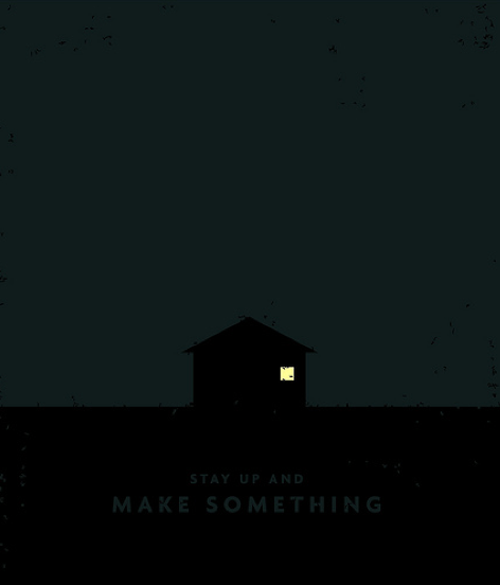
stay up and make something

How about you guys? What’re you up to?

Updates for the week of 2010-01-24

  • Nice to have been pretty much offline yesterday, though the catch-up phase this morning feels like opening up an overfull sitcom closet. #
  • In Internet speed, the USA is 18th (http://bit.ly/6OJkco) – I wouldn't mind living in Ireland… or Prague. #
  • Kaylee has acquired her first teenybopper earworm, and sings the chorus nigh-continually. http://bit.ly/73EAOs #
  • Adrift: The station proposes an alliance — access to some resources it has available, in exchange for ’some help w… http://bit.ly/6Gioe7 #
  • Pondering a virtual writer's group, managed via blogging software, weekly updates per author, feedback via comments. Good/bad idea? #vwg #
  • Watching @daphneun dance the chaleston. While seated. To scandinavian hiphop swing. #
  • Exactly. #
  • Dayjob promises/threatens to be breathtakingly busy for the next couple weeks. Already affecting my critical afternoon newsreader refreshes. #
  • Adrift: Deirdre, “of course”, will not be allowed further into the station and, if we will not allow her to be sho… http://bit.ly/8KtRmW #
  • Checking out a charter school for next year. Fingers crossed. The students we met were so impressive. Wow. #
  • Obama: Daddy of the United States of America (http://goo.gl/NLql) – "… the political party for people who want to hit their kids." #
  • Dear Subway marketing crew: "taste-tacular" deal sounds like something else. #
  • Via Judd — Ani DiFranco – If You're Not: http://youtu.be/3maav6s2iYo #
  • Incredibly productive day-jobbing this week. Not so for all other activities. Not sure how/what (if anything) I feel about that. #
  • Store name of the day: Ptereodactyl Ptoys. Sweet! #