A shout out to those who are waaaay behind on word count. I am with you here. We will triumph. Seriously. Those people who already have 20,000 words are using robots and house pets to write their novels for them while they sleep. We don’t need that kind of help. We are tough. We are slow.
We will make it up this weekend.– Chris Baty, NaNoWriMo 2002
It’s Day Eight. You made it.
“Made what? she asked, carefully avoiding any adverbs. Wait… dammit.
Lemme explain.
There’s this interesting pattern that people fall into in doing anything difficult or new (like trying to adopt a habit of writing 1700 words every day) — many falter or fall off the wagon at the same, seemingly arbitrary points.
The magic numbers are 3, 7, and 21.
See, if people are going to quit something like a new exercise plan, or meditating in the morning, or whatever, they usually do it on the 3rd, 7th, or 21st day. I don’t think anyone really knows why this is, but it’s an actual thing that happens.
Pat yourself on the back: if you’re still seriously working on your project, you have passed two of the three giving-up hurdles.
You get ideas from daydreaming. You get ideas from being bored. You get ideas all the time. The only difference between writers and other people is we notice when we’re doing it.
I usually aim for the middle ground on first drafts — I know it’s not going to be perfect, but I aim for a solid B to B+ range. Hell, I’m going to go through five drafts anyway — but if my first draft is littered with lots of little problems, I’m looking at six or seven drafts. Further, the little issues take a lot lot lot of time to go back and fix. So, for me, it’s a matter of economizing the process. Fixing small errors now — largely by making sure they don’t happen in the first place — actually saves me a shit-ton of time on the back end.
So here’s the thing. Chuck is totally right.
I’m walking a dangerous line here, because when you’re working a NaNoWriMo project, going back and editing is a phenomenally bad idea that will put you in the hole on wordcount faster than anything, so I don’t want to tell you to do any editing at this point. Perish the thought.
But there are a few things you can do using your brain-thinking-thing so the words you put down aren’t as bad as they might otherwise be. A few very very very simple rules you can follow.
However, I still wouldn’t mention them, except for one thing.
*looks around*
*leans in*
*whispers*
A couple of these rules, like the one I’m going to talk about today, will actually give you more words than if you don’t follow it.
Dirty Trick: No Adverbs
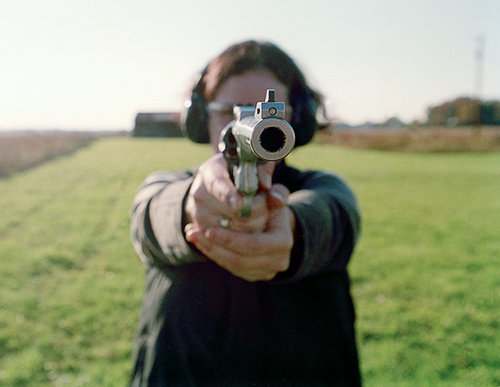
Sorry, did you just say "She held the gun tremblingly?"
The road to hell is paved with adverbs. – Stephen King
That’s a pretty strong vote against the adverb. It’s a pretty widely accepted rule among writers, though perhaps King is the most passionate about it.
Well, and me. I’m kind of rabid about adverbs, but not for the same reason. I don’t like them because they kill my word count.
Examples:
“What’s up?” he said smilingly.
*wince* Right. That sucks. Let’s try it without the adverb.
“What’s up?” he said with a smile.
Ehh. Better. Marginally less wince-worthy, and more words. Okay. Some people will grouse about how words can’t come with a smile, but whatever.
Now, once you’ve broken your two-pack-a-day adverb habit, you can take it a step further by avoiding those “with a…” phrases. I don’t know what they’re called in grammar books; prepositions? Maybe. Not all prepositional phrases are bad — most aren’t — but those ‘with a …’ phrases are really just a way of writing adverbs without writing adverbs. You’re cheating yourself.
“What’s up?” he said, smiling as he spoke.
Better! Considerably less suckitude. More words. Win/win.
Maybe you could…
“What’s up?” he said. He was smiling as he spoke; the particular smile I liked to imagine he saved just for me.
Bam. Maybe not the great american novel, but exponentially better than “smilingly”.
There’s your first dirty writing trick: No adverbs.
That happens. The first time I decided to do NaNoWriMo, I had already scheduled a convention for November 1st through the 3rd, so I hit the 4th with about 1300 words.
Maybe it was Day 3. You had two big, exciting, productive bursts, and then you hit Tuesday and work kicked your ass all day and you just knew there was no way you were getting to 5000 words.
Maybe it was Day 4 and you just … totally … forgot. Believe me, that happens.
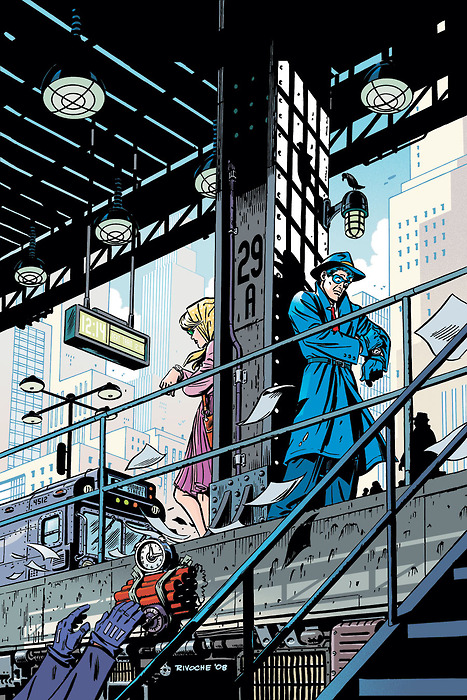
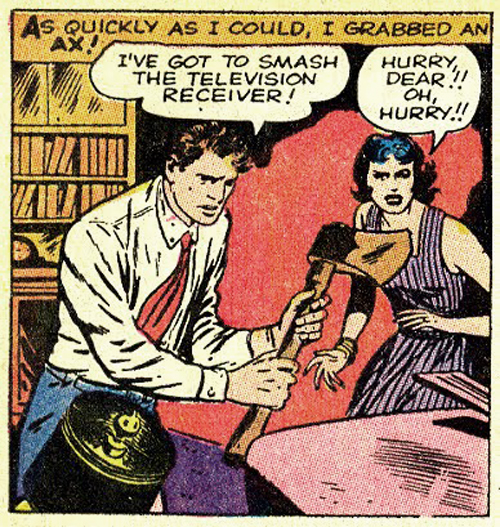
Maybe you’re a secret detective, and you made this fundamental error in judgement:
I'm running late, but I'm sure nothing else will come up...
Maybe you’re learning how to do podcasts, and your first one takes five and a half hours to finish up, instead of one. *looks guilty*
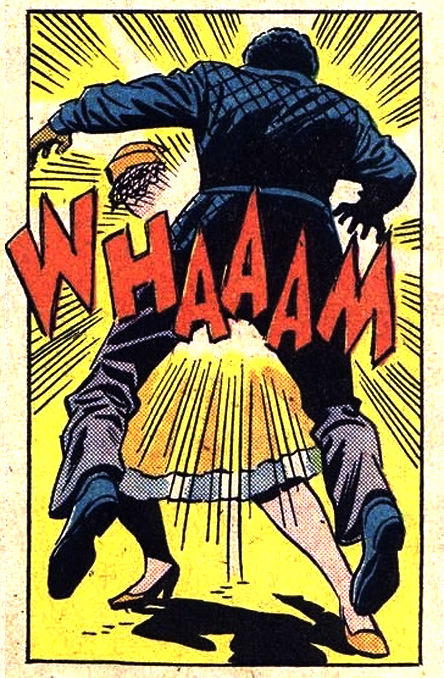
The details may vary, but the end result is pretty much the same: you, innocently standing there, and the daily wordcount for NaNoWriMo comes up and…
You needed how many words?
Knocks the air right out of you, doesn’t it? It’s okay, Tiger; shake it off. Sit on a chair and bounce up and down a couple times, with your legs together. It helps.
I talked a couple days ago about how we have to remember that all this writing stuff is supposed to be fun, or else why do it?
And that’s true. That’s absolutely true. But I need to share the other half of formula, and it’s pretty technical, so bear with me:
It’s also work. Work we love, yes, but work.
A writer is someone for whom writing is more difficult than it is for other people. – Thomas Mann
I don’t know if you can imagine doing something you really love as your actual for-pay job, but I want you to try. If you really can’t do it, try to find someone who has a job like that, and ask them if they ever get tired of it; if they ever feel like calling in sick so they can play Torchlight all day.
Feeling like that is easy to imagine, really, because we all feel like that sometimes. And we still go in. We still do the work. Maybe not always, but usually.
Thing is, this month, you need to have that “get it done anyway” attitude about writing. Even though you love it, because the day will come where you just don’t feel like it or you get discouragingly behind on your word count and you want to give up. You especially need to have that attitude on the day after you blew your writing goal and you have catching up to do. You’re going to have to take more than four of those elephant bites today; sit at the keyboard longer; stay up later than you’d like, and wake up tired.
It’s called “overtime”; butt in the chair, hands on the ‘board. Tappity tap.
Some people think that treating it like work will take away the magic of creation and imagination and the glittery pixies will abandon them and … I dunno. Whatever people like that say.
I have names for people who think like that. I call them “That guy that didn’t finish this year.”
So you’re behind.
Big deal. So am I. I’m gonna fix it.
Tonight, I’ll write until I get caught up. Tomorrow, I’ll write some more.
“Weekend” is just another word for “no one’s fucking interrupting me.”
Overtime. Work. Fun work, most of the time, but work.
Get to it. Let the pixies take care of themselves.
I’ve never done a podcast before, and I think it’d be fun.
I always, ALWAYS share whatever I’m writing for NaNoWriMo as I’m writing it, because (a) I have no shame and (b) it helps me stay motivated to keep at it.
And honestly? I don’t think it’s too damn bad. I’d welcome your comments and thoughts. Barring that, I just hope you enjoy it.
“Everything a writer learns about the art or craft of fiction takes just a little away from his need or desire to write at all. In the end he knows all of the tricks and has nothing to say.” — Raymond Chandler
I don’t give much in the way of actual writing advice, for two reasons.
You kind of have to figure that stuff out for yourself, or it won’t stick.
I don’t actually pay that much attention to writing advice. The only ‘writing book’ I’ve ever finished is On Writing, and I have to reread it periodically, because what I don’t already know didn’t stick.
Also: I give bad advice, and you shouldn’t listen to me. (So that’s three reasons.)
Also also: I’m not sure it makes things that much better. Okay, yes: I avoid adverbs and prepositional phrases absolutely as much as I can, within reason. (You see what I did there?) I try to use punctuation correctly and I check my Strunk and White when I’m not sure. That’s just mechanics, though; proper tool use.
But any discussion on style and theme and premise and that sorta stuff? Masturbatory, is what that is. (IMO, YMMV, Offer Void, et cetera.)
‘Style’ is ‘how you write’, which (a) you already have and (b) is changing throughout your life anyway so don’t worry about it. It’s like thinking really hard about your socks every time you take a step.
Theme and premise? Hell if I know.
Theme and premise are the kinds of things that make people ask “What were you trying to say when you first introduced the duplicitous character, standing in front of a building with a facade?” (At which point I’m thinking: “I dunno… it’s a shitty little street. Shitty buildings on shitty streets have facades.”)
Thinking about theme and premise while you’re in the middle of your first draft (to bleed out my analogy even further) is like looking through a telescope to see where you’re going on your walk: you fall down a lot and you don’t see a goddamn thing where you actually are.
Anyway: that kind of stuff will come out unconsciously in little hints and ghosts as you go through the first draft. Revisions and 2nd (and 3rd, and 4th) drafts find those little ghosts and hints and strengthen them into recurring themes and (if you’re inclined toward it) A Message. They are not things you should dwell on during initial writing.
Now, all that stuff up above could possibly be mistaken for Writing Advice, but it isn’t. I’m not telling you about something you should do, I’m telling about shit you shouldn’t do. Should not, in fact, even think about.
Why do I even mention it, then?
Because today is Day Five, and sometime either today or tomorrow you’re going kind of get your bearings on the story — to get a sense of what’s actually happening. Your characters will stop flailing around quite so much and actually Set Out To Do Something.
And you might catch the barest hint of something that looks like a Theme. (Or a Premise, maybe; fuck if I can tell em apart.)
And in seeing that strange beast for the first time this month, you might feel compelled to pursue it.
Do not. Just keep piling on the words. Keep telling the story.
Don’t get fancy. Don’t have a style. Just write things the way you write things.
Let’s go back to the righteous Reverend Chandler.
“Throw up into your typewriter every morning.” – Raymond Chandler
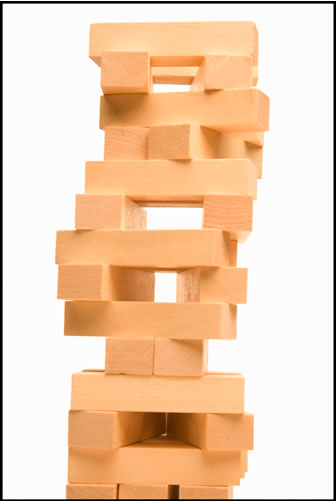
Babble on, guys. Build the teetering, leaning, unstable tower. When you hit that point (and you will) where you realize that – maybe – you know what shape the thing should be when it’s done, don’t freak out. Don’t let on; don’t give it away.
Just a quick post today. By tomorrow, you’re going to actually know where the story is going for, like, the first time, and we’re going to talk about that, but for today? Quick post.
You’re writing crap.
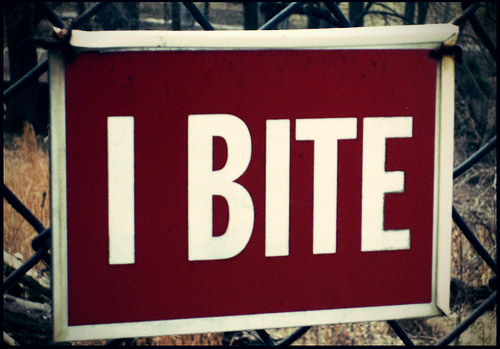
Yes, you’re biting that elephant to death, but in another very real way you are, as the kids say, “biting it.”
And that’s okay. There’s a freedom and joy in the first draft, because the stuff you’re writing, you’re writing for YOU, and if it sounds horrible the second time you read it, that’s fine, because at least during the process of getting it down on paper, it was awesome.
It brought you joy.
It was play, and sometimes the result of play is dirt and stained clothes and sand in your bathing suit area that will take a week to get out.
We have a lot of sand in our bathing suit area right now, don’t we?
So… let’s see it! (Not the bathing suit area. Eww.) Hop into the comments and trot out the most overwritten chunk of text you’ve dumped on the screen so far. I wanna see!
And, just to prime the well, here’s one of MANY POSSIBLE EXAMPLES from Adrift.
The Drift — what little of it I could see of from our vantage point — was the same as I remember: a vast patchwork quilt of mismatched metal; multi-millennia-deep piles of ships welded into a moon-sized satellite that predates any written history to which anyone from Caliban has access. It’s unsteady orbit – the source of its name – circled an otherwise unremarkable star on the border between what the Concordant Navy called ‘controlled space’ and the Remnants; a location that attracted any number of unsavory Remnant species, vagabonds, vagrants, traders, beggers, mercenaries, killers, crime lords, and those too unlucky to get away from them. It was a huge, dead, beast’s carcass infested throughout by millions of parasites and scavengers.
I picked this paragraph at random.
Just… for fun… try to count the times I switch between present and past tense. And forget about all the needless exposition. Sweet jumpin’ Jesus.
In edits, that paragraph is going to be like… one sentence.
But right now, it’s WORD COUNT, baby, and more importantly, I had fun writing it.
I had fun.
Writing for a living is a fine and good thing (in one way or another, that’s what I do, even at the day job), but the key thing to remember is we love this.